by SFT | Jun 7, 2026 | St Francis
Kouga Unveils Major Infrastructure Investment Programme for 2026/2027 and is set to roll out a significant capital investment programme for the 2026/2027 financial year, with major infrastructure projects aimed at improving service delivery, expanding basic services and upgrading critical municipal infrastructure across the region.
The investment forms part of the municipality’s continued drive to address infrastructure backlogs while supporting economic development and improving quality of life for residents.
Funding Supports Infrastructure Development
The programme is funded through a combination of Municipal Infrastructure Grant (MIG), Upgrading of Informal Settlements Programme (UISP), Water Services Infrastructure Grant (WSIG), Integrated National Electrification Programme (INEP) allocations and internal funding sources.
Together, these funding streams will support a wide range of projects focused on roads, sanitation, water supply, electrification and community infrastructure.
Municipal Infrastructure Grant Projects
Municipal Infrastructure Grant (MIG) funding will support several key projects, including the procurement of specialised waste management vehicles valued at R1 530 899, the upgrade of the Phillipsville Sportsfield at R6 275 776, and the upgrading of gravel roads across Kouga amounting to R10 337 345.
Additional MIG-funded projects include the refurbishment of the sewer pump station in Arcadia Street for R2 623 984, the upgrade of the Ocean View sewer pipe at R6 123 132, and the design phase for new high-mast lighting infrastructure valued at R4 347 826.
Investment In KwaNomzamo
Under the Upgrading of Informal Settlements Programme (UISP), the municipality will invest in the construction of a new sewer pump station and rising main in KwaNomzamo valued at R15 965 217.
A further R1 679 361 has been allocated for environmental impact assessment processes and internal reticulation design work.
The Water Services Infrastructure Grant (WSIG) will fund the KwaNomzamo bulk water project to the value of R10 074 782, aimed at strengthening water supply capacity and improving reliability for households in the area.
Electrification And Water Upgrades
In addition, the Integrated National Electrification Programme (INEP) will facilitate the electrification of 1 250 households across Kouga, with an allocation of R5 026 086.
Internal municipal funding will also be utilised for the replacement of the distribution system in Jeffreys Bay, with an investment of R2 000 000.
These projects are expected to improve access to essential services while strengthening infrastructure reliability across the municipality.
Community Infrastructure Improvements
Smaller but important infrastructure projects funded through internal allocations include the construction of a new sewer rising main valued at R344 883, bridge and culvert repairs at R600 000, and the construction of sidewalks and accessible pedestrian walkways amounting to R850 000.
Further allocations include R245 640 for the installation of street names and signage, R400 000 for the reinstatement of stormwater infrastructure, R600 000 for roads resealing and maintenance, and R800 000 for the fencing of sewer pump stations.
Commitment To Sustainable Growth
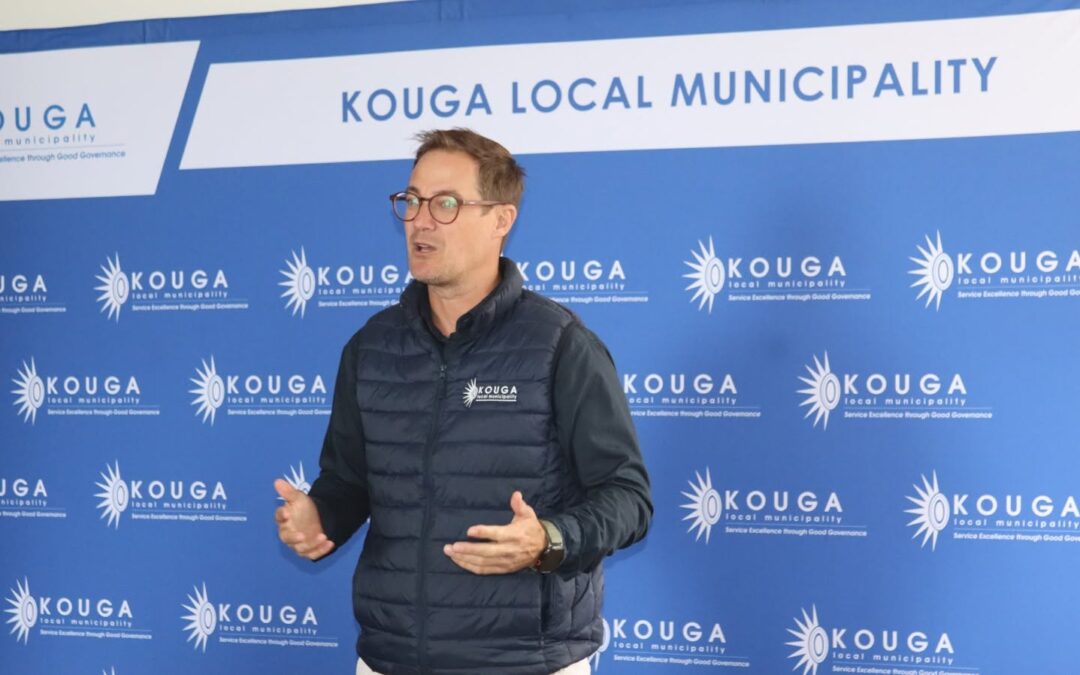
Kouga Executive Mayor Hattingh Bornman said the capital programme reflects the municipality’s commitment to sustainable development and improved service delivery across all communities.
“This capital investment programme is about delivering real, visible change in our communities. We are prioritising infrastructure that improves daily life, strengthens service delivery systems and lays the foundation for long-term economic growth. Every project included in this budget has a direct impact on the wellbeing of our residents,” said Bornman.
He added that the municipality remains focused on ensuring that infrastructure investment is both strategic and inclusive.
“We are deliberately investing in both bulk infrastructure and community-level upgrades because development must be felt in every ward. From roads and water to sanitation and electrification, these projects reflect our commitment to building a more functional, connected and resilient Kouga,” he said.
Building For The Future
The 2026/2027 capital programme represents a substantial investment in Kouga’s future. Through targeted spending on roads, water, sanitation, electrification and community infrastructure, the municipality aims to strengthen service delivery while creating a foundation for long-term growth and development across the region.
—
Read more: Rain, Panic And Rural Indonesia – Notes From The Editor
by SFT | Jun 7, 2026 | Notes From The Editor, St Francis, Surf Editorial, Travel News
There were moments in the taxi when I thought he was going to die, here, in a taxi on a nondescript road in rural Indonesia.
The rain hammered against the windscreen as we raced through rural Indonesia on the island of Sumbawa towards the nearest hospital. Scooters appeared from nowhere. Cows wandered across the road. The driver overtook lumbering cattle trucks on blind corners. Every minute felt important.
In the back seat, a badly injured surfer drifted in and out of awareness while his wife held him upright and spoke to him constantly.
Earlier that afternoon, the day had started perfectly.
The waves were firing. Surfers filled the lineup. Then suddenly there was shouting in the channel.
Trouble In The Channel
A surfer had suffered a heavy blow to the head and spent a significant amount of time underwater before being rescued and brought to shore.
When he arrived on the beach he was conscious, but only just.
He seemed confused. He struggled to answer simple questions. Most concerning of all, he repeatedly complained that he could not breathe properly.
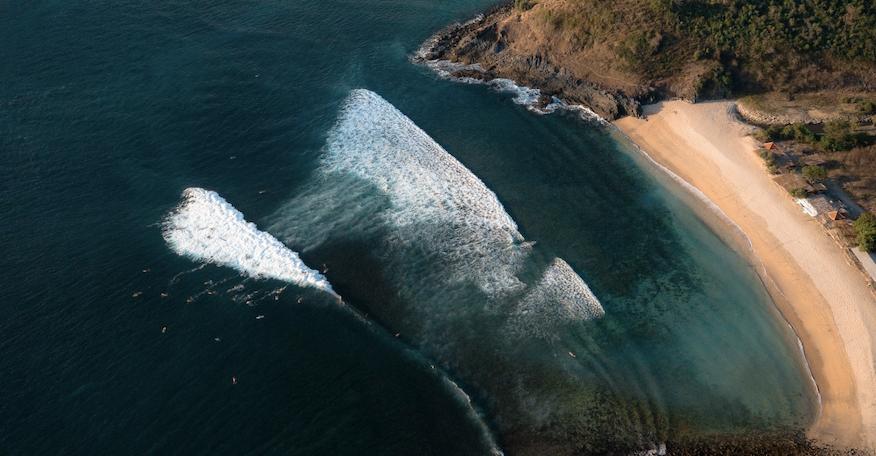
As often happens in remote places, plenty of people wanted to help. Advice arrived from every direction. Everyone meant well. Very few people knew exactly what to do.
The priority seemed obvious.
Keep him calm.
Help him breathe.
Get him to a hospital.
Eventually, the transport arrived.
It took several of us to carry him into the vehicle. His wife climbed in beside him. I climbed in as well with these two strangers, for support.
Nobody else seemed particularly enthusiastic about an hour-long taxi ride through rural Sumbawa to the very rudimentary RSUD Dompu (Rumah Sakit Umum Daerah Dompu), the public hospital serving the Dompu region of Sumbawa.
One Long Hour
The next hour felt considerably longer than sixty minutes.
We spoke to him the entire way, and we encouraged him. We reassured him, and we counted down the kilometres, asking simple questions to keep his mind working.
Whenever he replied, everybody relaxed slightly.
Whenever he fell silent, the anxiety returned.
Eventually, we arrived.
The hospital was crowded, chaotic and operating under pressure. Nevertheless, doctors and nurses immediately got to work.
Tests followed.
Treatment followed.
Then the seriousness of the situation became clear.
Blood Oxygen Saturation
Doctors discovered a significant head wound. They found fluid in his lungs. Most alarming of all, his blood oxygen saturation had fallen to around 67 per cent, a figure frighteningly low by any standard.
For a while, nobody offered predictions.
Fortunately, the oxygen levels slowly climbed. His condition stabilised. The immediate danger passed.
By the following day, he was able to stand. Soon afterwards, he was walking like Robocop.
The surfer recovered.
His wife got her husband back.
The doctors did their job.
After all the stress, uncertainty, panic, tropical downpours, overloaded cattle trucks, a serious head injury, oxygen levels of 67 percent and an hour-long race to the hospital, I learned one thing.
A developing rural corner of an Indonesian island, populated by farmers and fishermen, crossed daily by overloaded cattle trucks, hammered by tropical rain, floods and landslides, and corruption, still has better roads than St Francis Bay.
the editor
—
Read more: Rip Curl Vic Bay Surf Pro Adds New Prizes And Partner Activations
by SFT | Jun 7, 2026 | Financial Planning, St Francis
All Small-Scale Embedded Generation (SSEG) systems must be authorised by Kouga Local Municipality before installation. This requirement helps ensure that systems are safe, compliant, and legally connected to the municipal electricity network.
SSEG systems include solar photovoltaic (PV) installations, battery-only storage systems, and alternative energy technologies such as wind, biogas, generator, and micro-hydro systems.
Safety and Compliance
Firstly, municipal registration helps protect both residents and municipal employees. Incorrectly connected or unapproved systems can create serious safety risks, including electrocution and fire hazards.
In addition, unregistered systems may affect insurance claims if damage or accidents occur. For this reason, residents are encouraged to ensure that all systems meet the required safety and compliance standards before use.
Supporting the Electricity Network
At the same time, proper registration helps the municipality manage the electricity network more effectively as more households adopt self-generation solutions.
Unregistered systems can place additional pressure on the grid and may affect the reliability and stability of electricity supply in surrounding areas. Authorised systems therefore support better planning, monitoring, and long-term network management.

Work With Qualified Installers
Residents should work with qualified installers who understand municipal compliance requirements. Furthermore, homeowners are encouraged to confirm that quotations and service agreements include all required documentation, testing, and certification costs.
Importantly, registration and authorisation through the municipality are free of charge. However, installers or third-party service providers may charge professional fees to assist with applications and compliance processes.
By registering SSEG systems correctly, residents contribute to a safer, more reliable, and better-managed electricity network across the Kouga region.

by SFT | Jun 7, 2026 | Financial Planning, St Francis
Budget! A word feared in most households.
One of the biggest causes of arguments in households is money. We battle to speak about it, so we push it to the side to be discussed another day. Of all money subjects, a budget is the most important yet neglected tool we should all use.
It is easy to see a budget as something negative, restrictive, controlling, and even untrusting. But if we view it differently, it can be the base on which we build the current and future lives we want. When we want to build a business, a house, buy a car, or go on holiday, we start with a budget which reveals certain options or possibilities to us.
Personal or Household Budget
In a similar way, we should have a personal or household budget which covers fixed and lifestyle expenses, including short- and long-term savings. This budget must not be more than the family income, or it will not work or give a sustainable outcome. Having a budget which we stick to will, instead of making us fearful, give us a feeling of control and allow us to feel positive about the future.
If your financial planner has not asked you to do a budget, let alone update it annually, then you should question how they can give you the advice you need currently, let alone plan for your future retirement. At Client Care, we assist our clients in creating their personal budget in their current positions, as well as what it will look like in retirement. We use cashflow modelling to show what their future outcomes are and then help them understand the trade-offs they can make either now or in the future to make their personal plan work.

If you do not use budgeting, you simply cannot be in control of your financial life. Don’t know where to start? Give us a shout. It starts with the first step.
Dirk Groeneveld, Certified Financial Planner
t. 083 261 9287
e. dirk@clientcare.co.za
An Investment Portfolio Without a Plan is Meaningless
Five Dangers Of DIY Financial Planning
Finding The Delicate Balance In Giving
Dead Money, Living Money
—

Disclaimer:
This article is for information purposes only and does not constitute financial advice in any way or form. It is important to consult a financial planner to receive financial advice before acting on any information contained herein. Client Care and PWM and its directors, officers, and employees shall not be responsible and disclaim all liability for any loss, damage (whether direct, indirect, special or consequential) and/or expense of any nature whatsoever, which may be suffered as a result of, or which may be attributable, directly or indirectly, to the use of, or reliance upon any information contained in this article.




Recent Comments