
by Craig Jarvis | Oct 22, 2026 | St Francis
Kouga Local Municipality is expanding its public safety programme with a range of new technology-driven initiatives, including a free panic button for vulnerable women, drone monitoring along identified school routes, enhanced beach safety and search-and-rescue capabilities, and improved protection for municipal infrastructure – all aimed at strengthening emergency response and creating safer communities.
KOUGA – Kouga Local Municipality is strengthening its commitment to safer communities through a one-year extension of its Drone-as-First-Responder (DFR) programme, introducing expanded public safety capabilities aimed at protecting residents, supporting law enforcement and improving emergency response times.
First launched in March 2025, the programme operates from the municipality’s Incident Command Centre (ICC) in Humansdorp, using drone technology to provide emergency responders with aerial support during incidents involving crime, accidents, fires and floods. The expanded partnership with public safety technology company UrSafe Public Safety. will extend these capabilities to school routes, beaches, municipal infrastructure and other identified safety hotspots.
At the heart of the expansion is a free panic button service for vulnerable women and survivors of gender-based violence (GBV), connecting users directly to the ICC for assistance.
Member of the Mayoral Committee for Safety and Security Services, Alderman Daniel Benson, said the initiative demonstrated the municipality’s commitment to making public safety a priority and using technology to protect those who need it most.
“Every resident deserves to feel safe in their home, on their way to school or work, and in their community. By expanding this programme, we are strengthening our ability to respond to emergencies, support our law enforcement officers and provide additional protection to vulnerable residents,” said Benson.
“The free panic button is particularly important in our efforts to address gender-based violence. In an emergency, every second matters. Providing women with a direct link to our ICC can help responders identify their location and coordinate assistance more quickly.”
The panic button will enable participating users to send an alert, together with their location and identifying information, to the ICC. Operators can then coordinate an appropriate response, including dispatching a drone and alerting nearby patrol units. Registration will be coordinated through the municipality, local GBV support organisations and community safety structures.
The expanded programme will also introduce monitoring of identified school routes during designated hours, helping operators identify potential threats and alert patrol units when intervention is required. Along the coastline, drones will support beach safety and search-and-rescue operations by helping locate distressed swimmers and guiding lifeguards and rescue teams towards them.
Technology will also be used to protect municipal infrastructure, including reservoirs, pump stations and electricity substations, which are vulnerable to theft and vandalism. Night-time drone operations, using thermal imaging and night-vision capabilities, will further support law enforcement and search-and-rescue teams in difficult conditions.
“Protecting our infrastructure is also about protecting our communities. When cables are stolen or municipal equipment is vandalised, residents ultimately bear the consequences through service interruptions and additional repair costs. This technology gives our teams another tool to help prevent crime, safeguard essential services and respond more effectively,” Benson said.
The extension includes additional drone coverage, body-worn cameras for officers, detection of unauthorised drones near sensitive sites, and improved integration between emergency dispatch and digital evidence management systems.
The integrated system is intended to bring drone footage, body-camera recordings and incident records together, helping investigators compile reports and manage evidence more efficiently.
According to the programme information supplied by UrSafe, its digital evidence system has reduced case-reporting times in deployments to date from 13 days to less than five minutes.
The municipality’s ICC already combines drone operations with a network of more than 300 municipal and private security cameras. The expanded programme aims to strengthen coordination between emergency operators, law enforcement and other responding agencies.
Benson emphasised that technology would complement, rather than replace, community-based policing and the work of officers on the ground.
“Technology is most effective when it supports people. Our officers, emergency personnel and community safety partners remain central to protecting Kouga. These additional tools will help them make better-informed decisions, reach incidents more effectively and strengthen accountability,” he said.
The programme will operate within applicable privacy and data-retention requirements, with access to recorded evidence subject to controls and audit trails.
As Kouga continues to grow as a residential and tourism destination, the expanded DFR programme represents another step towards a coordinated approach to public safety – combining technology, responsive services and community partnerships to help create safer neighbourhoods for residents and visitors alike.
“I would like to thank Alderman Daniel Benson for the leadership, commitment and effort he has invested in driving this project to where it is today,” said Kouga Executive Mayor, Hattingh Bornman. “His role in advancing this initiative has helped turn an innovative concept into a practical public safety programme that can make a meaningful difference in our communities.
“This is an important investment in the safety of our towns and the people who live in them. We want Kouga to be a place where families feel secure, businesses can operate with confidence, tourism can flourish and economic opportunities can grow. Initiatives such as this demonstrate our commitment to working towards that future.”

by Craig Jarvis | Aug 12, 2026 | St Francis
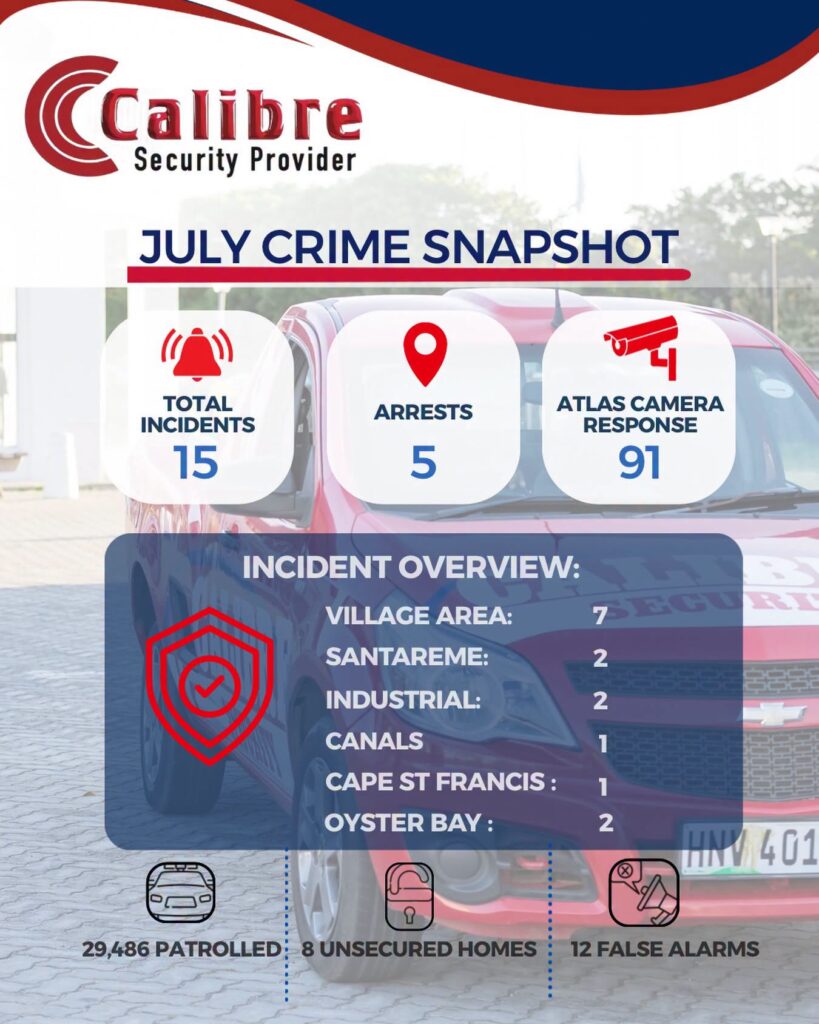
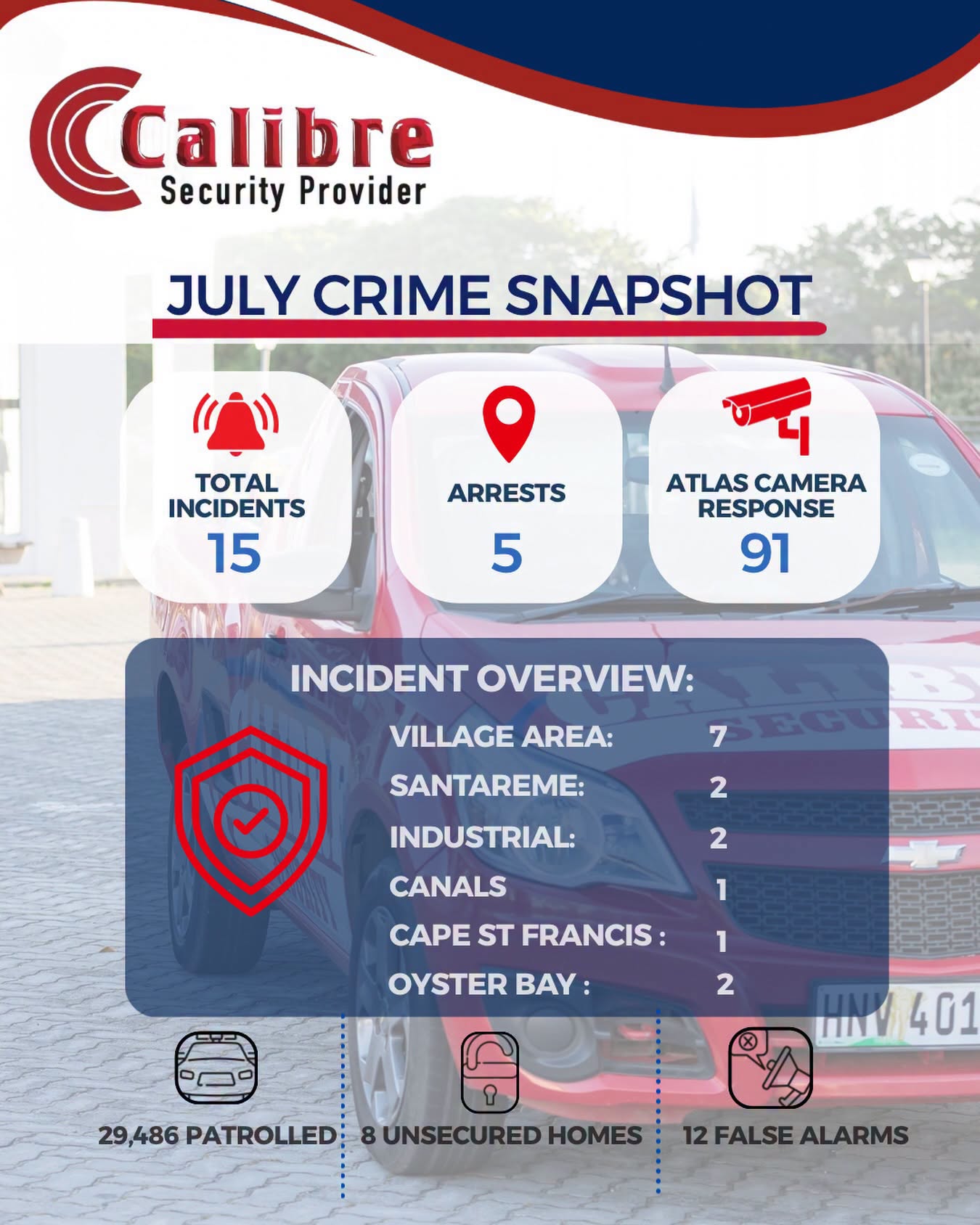
The St Francis crime snapshot for July brought some encouraging news for St Francis, with reported security incidents dropping from 19 in June to 15 in July. Calibre Security also recorded five arrests, while several stolen items were successfully recovered.
No Incidents Reported in Rebelsrus and Kromme Road Areas
There were no reported incidents during July in:
- Rebelsrus
- Kromme / Oyster Bay Road areas
Calibre Security thanked residents for their continued support, vigilance and cooperation.
Village Area Records Seven Incidents
Seven incidents were reported in the Village area during July.
Five were theft-related and involved items including a bicycle, copper pipes, cables and a gate-motor battery.
There were also two attempted housebreakings. Cables were stolen during one incident, while nothing was taken during the second.
One Incident Reported in the Canals
Paddles were stolen from a boat in the Canals area. However, the paddles were recovered and the suspects were apprehended.
Two Incidents in the Industrial Area
Two incidents were reported in the Industrial area.
The first involved an attempted theft. Response officers recovered stolen speakers after the suspects fled.
In a separate incident, thieves cut an electric fence before stealing steel pipes and an air cooler.
Two Incidents Reported in Santareme
A stolen pool pump was recovered in Santareme, and the suspect was apprehended.
In another incident, a suspect attempted to steal solar lights. Calibre response officers subsequently located the suspect.
Cape St Francis Housebreaking
One housebreaking was reported in Cape St Francis. Entry was gained through a bathroom window, although no items were stolen.
Two Housebreakings in Oyster Bay
Oyster Bay recorded two housebreakings during July. A television and vacuum cleaner were stolen during one of the incidents.
Five Arrests and Several Recoveries
Calibre recorded five arrests during July.
Recovered property included:
- Copper
- A bicycle
- Paddles
- A pool pump
Overall, reported incidents decreased from 19 in June to 15 in July. In addition, response teams apprehended several suspects and recovered stolen property.
Residents should remain vigilant, secure all access points and report suspicious activity immediately.
Property Security Continues to Improve
Calibre recorded another improvement in property security during July. The number of unsecured properties decreased from nine in June to eight in July.
Residents are encouraged to continue making home and property security a priority.
False Alarms Decrease
False alarms caused by service providers also decreased, falling from 14 in June to 12 in July.
Property owners should ensure that all service providers notify the Calibre office before accessing a property.
In addition, alarm systems should be serviced regularly. An unserviced alarm can fail when it matters most, so residents are encouraged to book a system check.
Calibre Patrols Almost 30,000 km
Calibre Security patrol vehicles covered 29,486 km during July. Together with continued collaboration with SAPS and its dedicated response team, Calibre remains ready when it matters most.
Keep Calm and Call Calibre: 042 294 0038
Read more:
by Craig Jarvis | Jul 26, 2026 | Notes From The Editor, St Francis
One of the strangest things about living in St Francis is how quickly we stop seeing it.
Not the obvious things. We all notice a pumping swell at Seal Point or a pod of dolphins heading east. But the everyday changes are different. They happen so gradually that they become part of the background, until one day you stop and realise the place isn’t quite the same as it was a year ago.
Take the groynes.
They’re either the most talked-about structures in town or the most controversial. Everyone has an opinion, and social media has ensured we’ve heard most of them. Yet I wonder how many people have actually stood there for twenty minutes and watched the work unfold.
The coastline is changing
It isn’t dramatic. There’s no ribbon-cutting moment or overnight transformation. A truck arrives, a massive rock is lifted into place, another follows, then another. Sometimes work slows while larger armour rock is sourced from the quarry. Then it starts again. Day after day, week after week, the coastline is changing almost imperceptibly.
The funny thing about projects like this is that they only attract attention while they’re being built. A few years from now, children will scramble over those rocks, anglers will cast from them, photographers will include them in sunrise pictures, surfers will take the epic waves for granted, and visitors will assume they’ve always been there.
That’s how most good infrastructure works. We only notice it while it’s missing or under construction.
The same applies to plenty of other things around town.
A cup of coffee and an opinion
The walking paths, the harbour, the lighthouse, the bridges and even the rows of coral trees that define so much of St Francis all exist because somebody, somewhere, put in the work long before the rest of us arrived with a cup of coffee and an opinion.
Perhaps that’s why it’s worth occasionally standing still. Not to admire a construction site, but to remind ourselves that places don’t simply stay beautiful by accident. They are constantly changing, usually through the quiet efforts of people we’ll never meet, doing the hard work, finding solutions where they don’t exist.
By next summer, most of us will have forgotten how the groynes were built. We’ll simply enjoy the beaches a lot more. The best work in a town is rarely the work that gets remembered. It’s the work that quietly becomes part of everyday life.
—
Read more:
Meet Our New Editorial Assistant at St Francis Today – She’s The Real Deal
Rain and Panic And Rural Indonesia – Notes From The Editor
by Craig Jarvis | Jul 2, 2026 | St Francis
KOUGA – Kouga Local Municipality is investing approximately R5.9 million to expand electricity access to 703 households in informal settlements across the municipality, with projects currently underway and expected to be completed within the next few weeks.
The projects, which commenced in March 2026, form part of the municipality’s ongoing commitment to improving service delivery and creating safer, healthier, and more dignified living environments for residents.
The electricity upgrades are being implemented in three communities:
- Tjoksville, Thornhill: Approximately 143 households are benefiting from the project, with an investment of R2 million.
- London in Ocean View, Jeffreys Bay: Phase 1 and Phase 2 upgrades are underway, benefiting approximately 310 households at a cost of R4.5 million. A possible extension could see an additional 110 households benefiting in future.
- Sea Vista, St Francis Bay: Phase 2 of the project is currently underway, benefiting approximately 250 households through an investment of R2 million.
Kouga Executive Mayor, Hattingh Bornman, said the projects demonstrate the municipality’s commitment to ensuring that residents across Kouga benefit from improved basic services and infrastructure.
“Access to reliable basic services is essential in improving the quality of life of our residents. These electricity projects are about more than infrastructure – they are about creating safer communities, restoring dignity, and ensuring that residents feel the positive impact of service delivery,” said Bornman.
He added that the municipality remains focused on directing resources towards projects that make a meaningful difference in communities.
“Service delivery remains at the centre of our work. Through careful planning and investment, we continue to improve infrastructure and extend essential services to communities where they are needed most,” said Bornman.











Recent Comments