
by SFT | Jun 30, 2025 | St Francis
Humansdorp — or “Human se Dorp” after its founder Matthys Gerhardus Human, isn’t exactly a tourist hotspot. But if you find yourself there, here’s why it’s… memorable.
-
The Main Road Experience
Driving through Humansdorp’s main road is like stepping into a time capsule that no one bothered to open. It’s a parade of tyre shops, bottle stores, fast-food joints, churches, sports shops and government offices, all wrapped in a haze of diesel fumes and honking taxis. It’s noisy, busy, and strangely captivating. If you love people-watching and dodging potholes, this is your spot.
-
Chameleon Restaurant
Tucked away just off the main drag, Chameleon is the surprise star of Humansdorp. With solid food and surprisingly good service, it’s a rare patch of calm and flavour in a town that otherwise offers mainly booze stores, fuel stops and slap chips..
-
The Humansdorp Co-op: A Longtime Local Legend
The co-op’s been a fixture here forever, supplying everything from farming gear to groceries. Locals swear by it — not just for what it sells, but because it’s reliably cheaper than anywhere else around. Once you find it, you’ll wonder how you ever managed without it.
-
A True Working Town
This isn’t a place for tourists seeking beaches or art galleries. Humansdorp is where people live and work, with a vibe that’s equal parts gritty and genuine. Expect straightforward service and a community that keeps things real.
-
Close to Better Things
Humansdorp might not be your destination, but it’s the launchpad for JBay, St Francis Bay, and Cape St Francis, which are, as we know, beautiful spots just a short drive away. Think of it as the last stop before paradise.
-
It’s… Human
Named after a real person and full of real people, Humansdorp’s charm lies in its ordinariness. It’s not polished, it’s not pretty, but it’s authentically, unapologetically itself.
-
The Wind Farms: Silent Giants on the Horizon
Just outside Humansdorp, the wind turbines stand tall, spinning smoothly. They look like the world’s least enthusiastic cheerleaders, spaced 200 metres apart. Strange and graceful, they give the surrounding hills a sci-fi feel, a reminder that even a no-frills town like Humansdorp is part of the renewable energy future.
by SFT | Jun 30, 2025 | Notes From The Editor, St Francis
It’s the first of the month, and like clockwork, half of St Francis mumbles “rabbit rabbit” (or the more theatrical “white rabbit”) into the morning chill before the kettle’s even thought about boiling. Some say it’s for luck. Others do it because their gran told them to. Before 8 a.m., muscle memory often prevails over common sense.
But where did this weird little jol come from?
The truth is that nobody is really sure. One theory points to early 1900s Britain, where children were taught to say “rabbit, rabbit, rabbit” as soon as they woke up on the first of the month, presumably before they’d even reached for the coal scuttle or the chimney brush. The idea was that it brought good fortune, or at least a slight upgrade from whatever disaster the previous month had served up.
A Bizarre Tradition
Folklore also played its part. In old European superstition, animals that popped up uninvited (hares, foxes, owls) were seen as omens. Good or bad? Who knows. Depends on what they were doing. A rabbit hopping through your garden might mean luck. A fox eyeing your chickens, less so.
Lewis Carroll didn’t help matters. His jittery, watch-checking rabbit in Alice in Wonderland turned an ordinary woodland creature into a time-obsessed anxiety mascot, the sort of character who’d definitely panic-buy gas bottles and forget to feed the cat. And somehow, that became the mascot for a new month.
RAF Pilots
During World War II, RAF pilots reportedly muttered “white rabbit” before takeoff for luck, which feels oddly reassuring, considering what they were flying into. It’s a superstition with legs (possibly buck teeth), passed down through generations like a family recipe with no ingredients, no method, and absolutely fkall logic.
But that could be the charm. It’s not about sense, it’s about hope. A mumble into the big void that simply says: “Go easy on us this month, please, because it’s going to be cold and grey, and there’s a huge rain forecast,” or something like that.
Read more: St Francis Animal Rescue Holds Successful Pawtest to Advocate for Rescue Dogs
by SFT | Jun 30, 2025 | St Francis
Jeffreys Bay – With a rich background rooted in the Northern Cape, Elsa van Biljon’s journey from a childhood on a sheep farm in the Kalahari to leading urban development in Kouga Local Municipality is amazing. It is a testament to dedication and passion for town and regional planning.
Born in Sishen, Van Biljon spent her formative years in the vast landscapes of the Kalahari before completing her primary education at Askham Primary School. She matriculated in 1987 at Upington High School, setting the foundation for her academic pursuits. Torn between a career in education or nursing in her youth, she ultimately chose urban planning. A field that combines strategy, structure, and a vision for sustainable growth.
Elsa Van Biljon holds a BA degree from Stellenbosch University, earned between 1988 and 1990.
Urban Development
“I further specialised in urban development, attaining a Master’s Degree in Town and Regional Planning from the University of the Free State in 1992,” she said.
Her extensive knowledge and expertise led her to join Kouga Local Municipality in July 2015 as a town planner. Here she played a pivotal role in facilitating land development.
Recently promoted, Van Biljon expressed her excitement about stepping into a leadership role within the municipality’s Town and Regional Planning Department.
“I am thrilled about this opportunity and eager to embrace the challenges that come with it,” she said.
Her responsibilities now include overseeing urban expansion projects and ensuring sustainable growth within the region.
Passionate about her field, Van Biljon thrives on the constant evolution and complexity of urban development. “New projects bring new challenges, and there is never a dull moment in this department,” she explained.
Looking ahead, she is committed to working alongside her team to fulfill the municipality’s vision. “Together, we will strive to deliver exceptional service and build a community that flourishes,” she said.
Read further: Leave Only Footprints – photo of the day

by SFT | Jun 30, 2025 | St Francis
In a firm step towards bolstering public health and safety, Kouga Local Municipality’s Environmental Health Section empowered local entrepreneurs at a Spaza Shop Workshop hosted in KwaNomzamo and Hankey on 18 and 19 June.
Spaza shop owners gathered for two days of critical training, geared towards improving compliance with national food safety legislation and strengthening everyday hygiene practices.
The sessions unpacked the intricate requirements of the Foodstuffs, Cosmetics and Disinfectants Act (Act 54 of 1972) – a cornerstone of South Africa’s health framework – and shed light on how small business owners can meet legal standards while fostering a safer food environment for their communities.
“These sessions were not a checkbox exercise – they were a declaration of intent: that public health begins not only in hospitals and clinics, but in the very heart of the neighbourhood spaza shops. It was about equipping our local food vendors with the knowledge to protect lives,” said a municipal health official. “When our shopkeepers are informed, our communities are safer.”
Essential Topics
The workshop covered a wide range of essential topics, including:
- Food safety and hygiene protocols, from personal cleanliness to environmental upkeep.
- Minimum health standards for food premises, including storage, ventilation and illumination.
- Regulations on labelling, advertising, and transporting foodstuffs.
- The dangers of pest infestation and illegal dumping, and how to tackle them.
- Prohibition orders and the risks associated with sleeping in business premises.
- Law enforcement and the issuing of fines.
- Complying with town planning and building legislation and requirements.
By directly addressing 201 spaza shops across the Kouga region, the municipality reaffirmed its commitment to health education and economic support. The initiative also highlighted the strategic role of informal retailers in the wider public health ecosystem. A role often overlooked but vital in many low-income communities.
Kouga Spaza Shop Workshop
“Public health does not start in hospitals or clinics alone. It begins right in our communities, in places like the local spaza shops,” said Kouga Executive Mayor, Hattingh Bornman. “By empowering our food vendors with the right knowledge, we are taking vital steps to protect lives and build safer, healthier neighbourhoods for all.”

by SFT | Jun 30, 2025 | St Francis
All photos by Caroline Jones Photography
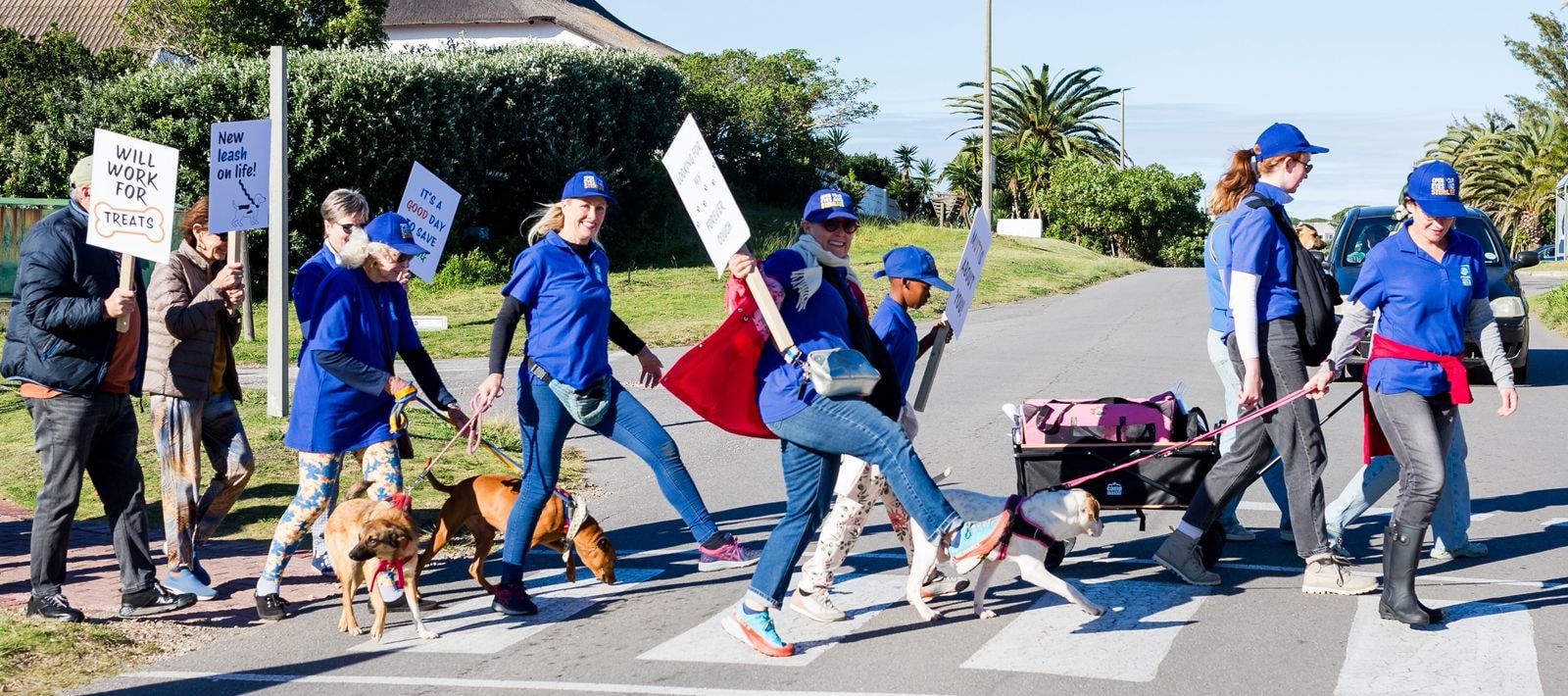
Saturday, 27 June 2025 – St Francis Animal Rescue (SFAR) held a vibrant and impactful *Pawtest* along the main street in St Francis Bay, drawing attention to the importance of adopting rescue dogs. Volunteers marched with placards, accompanied by 14 adorable SFAR rescue dogs, highlighting the message that rescue dogs make the best companions.
The event aimed to raise awareness about the increasing number of dogs being surrendered in Sea Vista, a trend that has reached alarming levels this year, and to encourage people to adopt rescued, mixed-breed dogs rather than buying pedigreed pure breeds.

Economic Challenges
“The economic challenges faced by our Sea Vista community have made it increasingly difficult for families to keep their pets, ” said Susan Rae-Fox, founder of SFAR.
“Many owners are forced to give up their dogs due to financial strain, while others leave Sea Vista or pass away, leaving their pets without responsible owners and on the streets. Older dogs, who have so much love to give, are often the first to be discarded.”
Current research suggests that mixed-breed dogs are less likely to develop inherited diseases that can affect purebred lines. A six-year study on over 1.6 million dogs revealed that mixed breeds and crossbreeds have a significantly lower risk of cancer compared to their purebred parent breeds.
Balanced temperaments
Mixed-breed dogs also often have more balanced temperaments because they are not bred for extremes in behaviour or appearance. This makes them excellent companions for families, first-time dog owners, and people looking for a steady, adaptable pet.
Tucker, Vince and Sophie are three beautiful Africanis who were recently found in Sea Vista with no owner in sight. Upon investigation by SFAR, it was found that the owner had been taken to jail, leaving the dogs to fend for themselves on the streets. The three were quickly picked up by SFAR volunteers. They are now boarding at a private kennel facility in Humansdorp, where they receive food, veterinary care, and regular walks.

Successful Pawtest
“SFAR is advocating for local residents to consider adopting these loving animals rather than opting for pedigree dogs from breeders. We invite the community to reach out to SFAR to meet the incredible dogs ready for adoption. Visit our Facebook Page to see the dogs looking for their forever homes. Together, we can change lives and promote the joy of adopting rescue pets!”
Further reading: The FOSTER Jol is Back





Recent Comments