
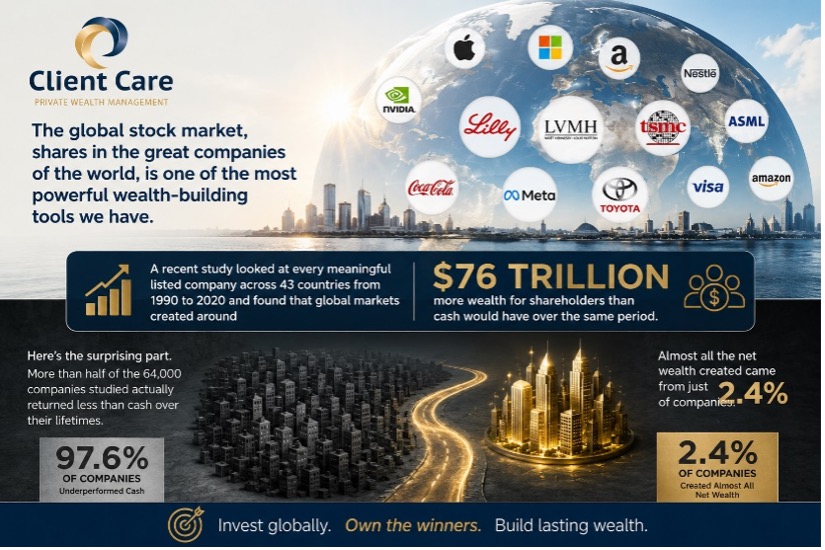
The global stock market, shares in the great companies of the world, is one of the most powerful wealth-building tools we have. A recent study looked at every meaningful listed company across 43 countries from 1990 to 2020 and found that global markets created around $76 trillion more wealth for shareholders than cash would have over the same period.

Here’s the surprising part. That wealth did not come from the market broadly. More than half of the 64,000 companies studied actually returned less than cash over their lifetimes. Almost all the net wealth created came from just 2.4% of companies.
So how does an ordinary investor get a slice of that 2.4%?
There seem to be two routes. The first is to try to identify those winners ahead of time. This is what much of the investment industry is built around, clever people, deep research, sophisticated models, all hunting for the same small group of exceptional companies. Yet the evidence is sobering. Most professional fund managers underperform the broad market over long periods, and even among those who do beat it, separating genuine skill from plain luck is notoriously difficult. Picking winners in advance is, for almost everyone, a losing game.
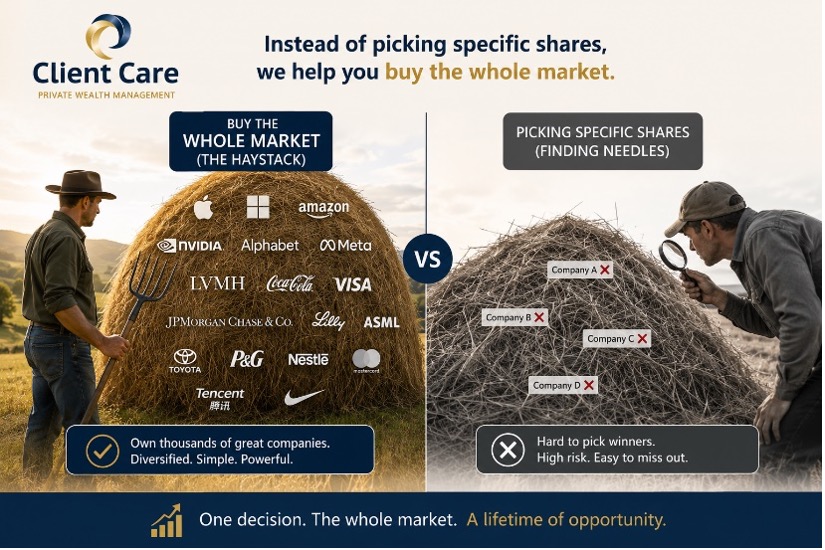
The second route is far simpler: buy the whole haystack instead of hunting for the needle.
A globally diversified fund holds every listed company of any real size. The next Apple, Microsoft or Nvidia is already in there somewhere, sitting alongside thousands of companies that will go nowhere. You don’t need to know which is which, you own them all, and so you automatically own the winners too.
This kind of fund has no opinion about whether a share is too expensive. It holds the big companies simply because they are big and keeps holding them as they grow bigger still. A skilled stock-picker might have sold Apple back in 2010, convinced it had already had its run. A broad index fund could never do that, it doesn’t form opinions, and that lack of opinion is precisely what keeps you riding the winners for as long as they keep winning.
None of this is a free ride, though. Owning the whole market means owning every downturn along with every winner. The reward only comes to investors who can stay calm and stay invested through the inevitable rough patches.
And this is really the heart of it. A good portfolio is only one part of a good outcome. A sound long-term plan, and the discipline to hold steady when markets wobble, matter every bit as much as the funds you hold. Behaviour, more than selection, tends to decide who does well over time.
So, ask yourself; are you, or whoever manages your money, trying to guess which companies will end up in that magic 2.4%? Or are you simply happy to own all of them?
Owning the haystack is the easy part. Building a plan around it, and having someone alongside you when markets get uncomfortable, is where the real value lies. If you’d like to talk through what that could look like for you, I’d be glad to have that conversation.
—
Dirk Groeneveld, Certified Financial Planner
t. 083 261 9287
Recent Columns
An Investment Portfolio Without a Plan is Meaningless
Five Dangers Of DIY Financial Planning
Finding The Delicate Balance In Giving
—

Disclaimer:
This article is for information purposes only and does not constitute financial advice in any way or form. It is important to consult a financial planner to receive financial advice before acting on any information contained herein. Client Care and PWM and its directors, officers, and employees shall not be responsible and disclaim all liability for any loss, damage (whether direct, indirect, special or consequential) and/or expense of any nature whatsoever, which may be suffered as a result of, or which may be attributable, directly or indirectly, to the use of, or reliance upon any information contained in this article.




Recent Comments