

One of the strongest voices yet in the debate over the proposed Thyspunt Nuclear Power Station came from the Wildlife and Environment Society of South Africa (WESSA) during a public meeting on Saturday.
Full credit to Kouga News for both the original reporting and the outstanding video coverage of the presentation. Their report captures the discussion in detail, while the video allows residents to hear Dr Gary Koekemoer’s comments in full and provides valuable context for one of the region’s most significant environmental debates.
WESSA Raises Concerns About Thyspunt
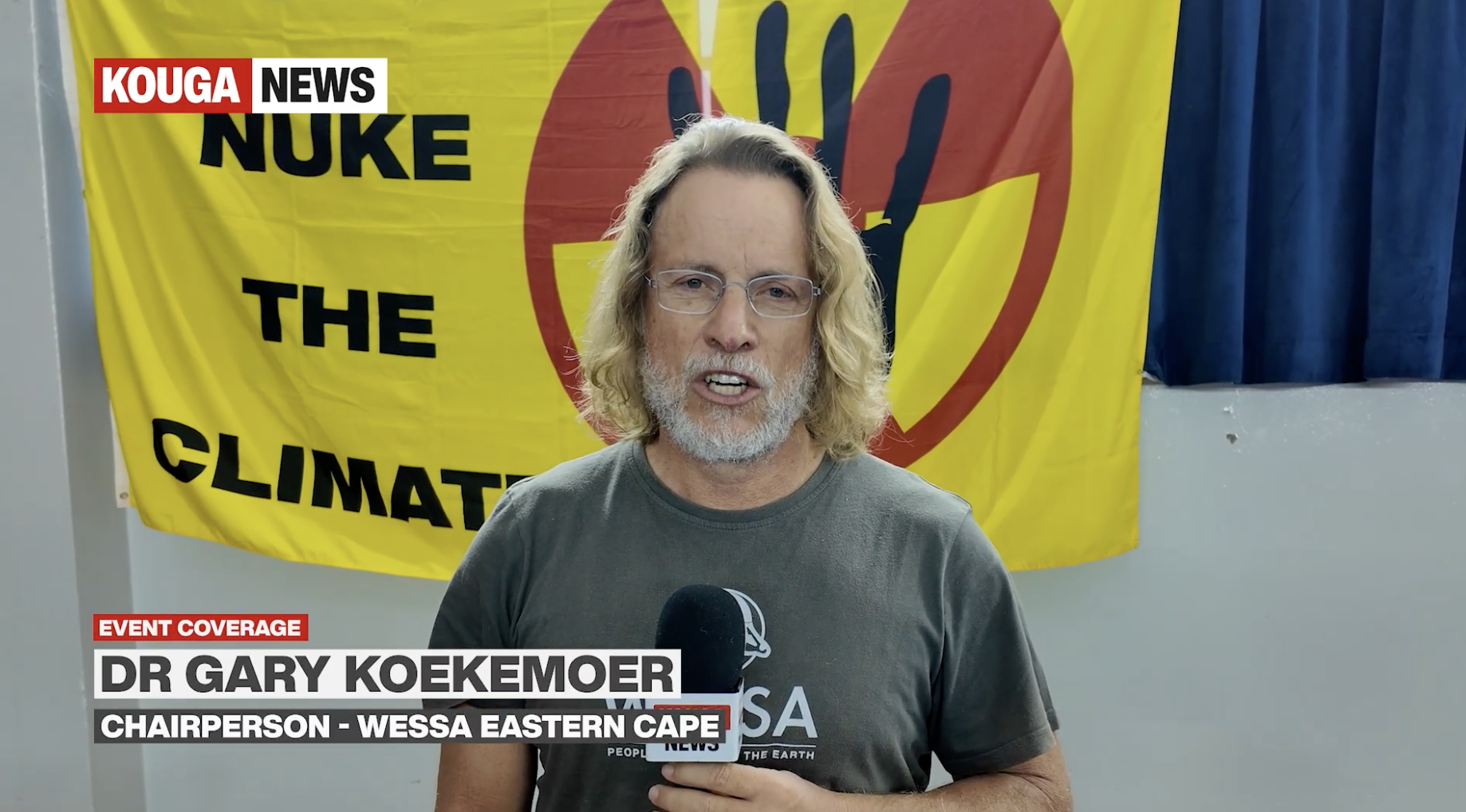
Speaking at an Earthlife Africa Johannesburg community meeting at Newton Hall, Dr Gary Koekemoer, Chairperson of WESSA’s Eastern Cape branch, explained why the organisation opposes the proposed nuclear development.
According to Koekemoer, WESSA believes Thyspunt is not an appropriate location for a nuclear power station. The organisation also argues that modern South Africa has access to better energy solutions than nuclear power.
He said the project could place enormous pressure on the Kouga region by attracting an estimated 15,000 people to Humansdorp. In his view, local infrastructure, water supplies, schools and accommodation are simply not equipped for that level of growth.
Video: YouTube
A Community That Could Change Forever
Koekemoer also warned that the development could permanently alter the character of the Kouga region.
“If we bring a nuclear plant here, your community will change forever. It is going to be fundamentally different.”
He said the proposal could also have implications for key local industries, including tourism and the Eastern Cape’s valuable chokka squid fishery.
An Alternative Vision For Thyspunt
Rather than industrial development, Koekemoer suggested Thyspunt offers an opportunity to recognise and celebrate Khoi Khoi history and heritage. He said WESSA believes the site could serve a very different purpose while protecting its environmental and cultural significance.
Before concluding, he thanked the Kouga community for its hospitality and for allowing WESSA to contribute to the ongoing discussion.
If you want the full context of Dr Koekemoer’s presentation, Kouga News has produced excellent coverage of both the meeting and the complete video. It is well worth watching to hear his comments in their entirety.
Source: Kouga News reporting and video coverage of the Earthlife Africa Johannesburg community meeting featuring Dr Gary Koekemoer, Chairperson of WESSA Eastern Cape.
—
read more: Meet Our New Editorial Assistant at St Francis Today – She’s The Real Deal



I see that Dr Koekemoer stands in front of a banner demanding “Don’t nuke the Climate”.
Not only am a scientist but I also have magic powers. I can grant wishes.
He asks that Kouga not be “nuked”. By that he means that, please, no Atomic Bombs should be dropped on Kouga.
One does not need to know much about History and Politics to believe that I’m perfectly safe in granting him that wish!
No, No, I suspect he’d answer, my concern is the release of radioactivity.
Really?!
Koeberg has been there since the mid 80’s producing electricity (until Egypt’s El Dabaa comes online) for Africa.
In all this time, it has not released radioactivity into the environment.
Despite this, there have been any number of reports screaming fear for all to hear.
My goodness, there’s one doing the rounds – as I type this.
Koeberg is operated safely. It reports to international organizations and it is evaluated by these organizations.
If at any time there is an incident which threatens anyone, this is reported – routinely. The current one is associated with maintenance currently under way. It was detected immediately and the necessary safety measures were put in place to protect workers from any harm. There was NO release to the public.
So what IS this “nuke” business Koekemoer is warding off?
Mr Editor, professional fear mongers are one thing. A public facility exploiting such fear mongering to drive the news cycle is another. There’s nothing science can do about “Dr” Koekemoer. He long since clearly decided to ignore science and live off fear-mongering. One can, however, do something about a newspaper twisting reality. The first step is to ask nicely.
Next time you decide to publish something Koekemoer has to say, please do the public the service of having a professional respond. I mean, South Africa has university departments teaching nuclear science. South African nuclear scientists were scattered to the winds when the PBMR project was put on “care and maintenance”. Try X-energy and Kairos Energy in the USA. Better still, stay home and try Next Gen Nuclear.
https://ngnuclear.com/
Thank you!
Here’s a reponse from a Nuclear Professional regarding the most recent radiation release incident reported by Koeberg.
https://www.facebook.com/share/p/1HmFtFMk8N/
Dr Kelvin Kemm should be in your list of professionals to contact when the topic “nuclear” arises.
Koekemoer (K, here-after) makes a number of claims, all requiring rebutted.
1. “Thyspunt is not the appropriate location for a nuclear power plant”. This after Eskom has looked for and identified two locations, conducting the necessary investigations into those locations. Notice the K is careful not to tell the listener what location IS appropriate. That’s because (I’ve little doubt!), K will not accept ANY location for a nuclear power plant. The dishonesty of not stating this up front is appalling!
2. “There is better technology than nuclear”. Again, notice that K is careful not to tell the listener what technology IS better! We need only look to Koeberg to see why nuclear is high on the list of suitability – Koeberg produces the cheapest, cleanest electricity in South Africa with the smallest footprint and the least damage to the environment.
3. K is appalled that building Thyspunt will create work in Kouga. In a country desperate for more work, K wants to exclude it is an area of the country particularly in need of work opportunities!
4. “The Thyspunt area will be permanently changed, detrimentally, particularly local industry”. Again. one need only look to Koeberg to see that this claim is false – indeed it’s pure fear-mongering. The Chokka industry in particular is not limited to a small area. Chokka is caught where it is currently to be found, not in one particular location – at Thyspunt! Chokka has a sea to live in. A Thyspunt Nuclear Power Plant’s (NPP’s) cooling water will influence a particular, limited, local area. Tourism? NPPs are not tourist attractions. They sit there doing their job. The tourism (beach usage) adjacent to Koeberg tells us what to expect from Thyspunt; a limited restricted area. Normal human activity continues around Koeberg. Residential areas extend to within about 2 kilometers of the NPP. In Google Earth one can measure that the closest clear human activity to Thyspunt is currently about 3 kilometers (a farmer’s fields to the North) away – with closest residences being about 4 kilometers away (Oyster Bay). Once built Thyspunt will be just another Koeberg; look at the prices of coastal properties adjacent to Koeberg – there are no fire sales here!:
https://www.property24.com/for-sale/van-riebeeckstrand/melkbosstrand/western-cape/8080
If I where K’s speech writer, I’d be perfectly honest: “I’ve never supported nuclear technology. I’ve always opposed it with every cell of my body. Thyspunt is merely the latest iteration in my obsessive rejection of modern science and technology.”
I have only one question for Dr Koekemoer: Have you signed a living will insisting that no nuclear medicine technology ever be used should you need it? SAFARI, South Africa’s medical isotope reactor has been producing medical isotopes for the world, since 1965 with output increasing significantly since the mid 1990’s. Given your consistent rejection of nuclear technology, I assume that includes any of the isotopes SAFARI produces! During a recent outage of SAFARI, Canada began producing medical isotopes in its power reactors. Thyspunt, in principle, could follow in Canada’s path. Not only would Thyspunt be a massive producer of cheap electricity, it could also be used for other purposes. Desalination comes to mind – Koeberg recently installed a groundwater desalination facility allowing it to produce all its potable water requirements.