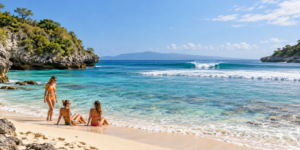
Bali Beach – Photo Of The Day
Bali Beach – Photo Of The Day

Bali Beach – Photo Of The Day
Lakey Peak remains one of Indonesia’s most unique surf destinations, combining world-class waves, raw coastal scenery and a village atmosphere that still feels connected to travelling surf culture rather than polished tourism.
Located in the Hu’u district on the island of Sumbawa, Lakey Peak sits roughly two hours from Dompu and requires commitment to reach. Most surfers travel via Bali, flying into either Bima or Sumbawa Besar before continuing by road through farming villages, mountain passes and long winding coastal stretches. The journey forms part of the experience. By the time surfers arrive at Lakeys, the outside world already feels distant.
The bay itself contains several well-known surf breaks within close proximity. Lakey Peak delivers its famous wedge-shaped peaks directly in front of the village and works across a wide range of tides and swell directions. Lakey Pipe offers heavier, faster waves with hollow sections that attract experienced surfers, while Periscopes and Nungas provide alternative options depending on conditions and crowd levels.
Life in Lakeys runs according to tide charts, wind patterns and surf forecasts. Dawn usually starts with scooters buzzing through the village roads as surfers head toward the checks. Warungs open early for coffee, nasi goreng and banana pancakes while the first offshore winds groom the reefs. By midday the tropical heat settles heavily across the bay and activity slows until the afternoon sessions begin.
The village remains relatively simple compared to many modern surf destinations. Small guesthouses, surf camps and roadside eateries line the beachfront road, with most accommodation offering direct views of the waves. Travelling surfers spend long evenings on balconies overlooking the bay, trading stories while watching the final surfers glide across sunset walls at Lakey Peak.
One of the defining features of Lakeys is the constant movement of international surfers passing through. Australians, Brazilians, South Africans, Europeans and travelling Indonesians all converge on the same stretch of reef, creating a strange but familiar travelling community built around tides, swell charts and shared routines.
The roads around Lakeys are famously chaotic. Scooters dominate the traffic and local driving customs take some adjustment for newcomers. Rear-view mirrors are often removed from scooters, with drivers relying heavily on horns and instinct while navigating the narrow roads. The system somehow works, although it can feel slightly alarming at first.
Despite its remote location, Lakey Peak has maintained its place on the global surf map for decades because the waves remain incredibly consistent. During strong swell periods the bay can produce multiple quality sessions per day, with offshore winds grooming the waves through large parts of the dry season.
What continues to separate Lakeys from many other surf destinations is the atmosphere. The village still feels slightly unpredictable, slightly rough around the edges and deeply connected to surf travel culture. Plans shift quickly, weather changes suddenly and every day develops its own rhythm depending on swell, wind and whoever happens to arrive in town that week.
For travelling surfers, that unpredictability forms part of the appeal. Lakey Peak remains less about luxury and more about immersion. The heat, the scooters, the reef, the warungs, the tropical storms and the long sessions all blend into a destination that stays with people long after they leave Sumbawa.Days and Nights at Lakey Peak
Daniel Benson (Member of the Mayoral Committee for Community and Safety Services), Hattingh Bornman (Kouga Executive Mayor), Lionel Mapoe, Chalwayne Lippert (Kouga Sports Council), and Elvina Felix (Kouga Sports Coordinator).
KOUGA – There is something powerful about coming home – not just to reminisce, but to rebuild.
For Lionel Mapoe, former Springbok rugby centre, the journey back to Kouga is a calling rooted in gratitude, resilience, and a deep desire to uplift the next generation.
As Kouga Local Municipality continues to position itself as a hub of opportunity and growth, Executive Mayor Hattingh Bornman welcomed Mapoe’s initiative.
“Mapoe’s decision to reinvest in Kouga is both inspiring and timely. It speaks to the power of giving back and reminds us that true success is measured not only by personal achievement, but by the lives we uplift along the way.”
Forged Through Adversity
For Mapoe, the defining moments of his career were not only the celebrated victories on the field, but the quieter, more difficult battles behind the scenes.
“The moments that shaped me the most were the challenges – injuries, setbacks, and times where things didn’t go my way,” he reflects. “But I had faith, I prayed, and I believed. Those moments taught me resilience, discipline, and how to stay grounded.”
While representing South Africa and lifting trophies remain career highlights, it is adversity that built his character. Rugby, he explains, is as much about mental strength as physical ability – teaching perseverance, teamwork, and unwavering commitment.
Roots in Thornhill: A Foundation of Strength
Mapoe’s story begins in Thornhill in Kouga Local Municipality, where humble beginnings laid the groundwork for his future success.
“I’m so grateful to my family – my mother, my aunt, my Ouma. They made sure I had shoes on my feet and clothes on my back. My Ouma passed away last year,” he said. “My upbringing fuelled the hunger in me to want to make a better life for my family.”
It is this deep-rooted sense of gratitude that continues to guide him. His connection to Kouga is personal, lived, and enduring.
Kouga: A Community of Potential
Growing up in the region, Mapoe understands both its strengths and its struggles.
“There is so much potential in Kouga, but there are also distractions,” he says. “It’s easy for a young person to walk away from their potential because of a lack of access – to facilities, mentorship, exposure, and opportunities.”
Challenges such as gangsterism and drug abuse remain pressing concerns. Yet Mapoe believes that with the right interventions, young people can be redirected toward purpose and possibility.
“If I can play even a small part in assisting, that’s something close to my heart,” he adds. “I want to influence kids positively and instill belief.”
The LM13 Rugby Academy: A Vision in Motion
At the heart of Mapoe’s mission is the LM13 Rugby Academy, a structured initiative aimed at nurturing young talent and creating meaningful pathways.
“We’re building structured rugby clinics and development programmes,” he explains. “The goal is to create consistent opportunities for young players to learn, grow, and be seen.”
While the initial focus is on rugby, the vision extends far beyond sport.
“Yes, sport is where we start—it’s a language most South Africans understand,” he says with a smile. “But I want to expand into mentorship, education, and other areas of development.”
The programme is set to launch in early September, with plans already underway behind the scenes to ensure a strong and sustainable foundation.
Building Partnerships for Lasting Impact
Mapoe emphasises that meaningful change requires collaboration. He is working closely with Kouga Municipality and the Kouga Sports Council to ensure the initiative is effectively implemented.
“It’s about building something special – creating systems, developing coaches, and getting the right support in place,” he explains.
Local businesses and stakeholders are also encouraged to play an active role, whether through sponsorship, resources, or direct involvement.
Empowering Youth Beyond the Field
While rugby is the entry point, Mapoe’s broader mission is youth empowerment in all its forms.
“To young people, I would say: believe in yourself, stay disciplined, and be patient. Your environment doesn’t have to limit your future.”
He is equally passionate about supporting those who may not pursue sport professionally.
“Not everyone will make it in sport, and that’s okay,” he says. “My goal is to create opportunities for growth in mindset, skills development, and confidence.”
Mentorship is central to this vision – guiding young people not only as athletes, but as individuals preparing for life’s challenges.

Kouga Local Municipality has approved urgent resolutions aimed at unlocking provincial and national disaster relief funding following the devastating floods that struck the region between 5 and 11 May 2026.
The flooding caused widespread destruction across the municipal area, with preliminary estimates placing damage to municipal infrastructure at approximately R170.3 million.
The resolutions were adopted during a Special Council Meeting held on 14 May 2026.
Council officially noted the municipality’s submission to the Sarah Baartman District Municipality requesting the declaration of a Local State of Disaster for the Kouga region.
The request followed severe flooding that damaged roads, electrical infrastructure, homes, bridges, stormwater systems, and other essential municipal services.
Council further resolved that the Sarah Baartman District Municipality submit the resolution to the Provincial Disaster Management Centre in terms of Section 41 of the Disaster Management Act 57 of 2002 for gazetting and escalation to the National Disaster Management Centre.
The official Flood Report covering the period from 5 to 11 May 2026 was also formally noted during the meeting.
Kouga Executive Mayor Hattingh Bornman said the municipality faced enormous financial pressure following the disaster.
“Initial high-level assessments place the estimated repair costs at approximately R170.3 million excluding VAT,” said Bornman.
“These figures are based on preliminary visual assessments, and the final costs may increase as detailed technical investigations continue.”
Bornman said the municipality did not have the financial capacity to absorb damage of this scale within its current budget.
“The declaration of a Local State of Disaster is therefore crucial to unlock provincial and national disaster funding needed to restore infrastructure and assist affected communities,” he said.
The severe weather followed days of intense rainfall linked to a cut-off low-pressure system over the Eastern Cape.
Between 5 and 7 May 2026, the South African Weather Service issued an Orange Level 8 warning for disruptive rainfall across the region.
In several areas, more than 100mm of rain fell within a short period, overwhelming stormwater systems and causing rivers to burst their banks.
One of the major contributing factors was the rapid rise of the Kouga Dam, which reportedly surged from around 40% capacity to above 100% within hours as heavy inflows entered the dam system.
By 7 May 2026, the dam had exceeded capacity, prompting emergency warnings and evacuation notices for residents living along the Gamtoos River and downstream flood-prone areas.
Among the worst-affected areas were Hankey, Patensie, Loerie, Thornhill, Gamtoos Mouth, Sea Vista, Oyster Bay, Humansdorp and parts of Jeffreys Bay.
Floodwaters inundated homes and informal structures across the region, forcing many residents into temporary shelters and community halls.
In Hankey, several families were evacuated to the Vusumzi Landu Hall after homes were flooded and access routes damaged.
At Kingsway in Gamtoos Mouth, 46 residents had to be evacuated after rising floodwaters threatened nearby homes and properties.
Sea Vista’s informal settlement area experienced severe flooding, with vulnerable households among the hardest hit.
In KwaNomzamo and Kruisfontein, strong winds ripped roofs off informal structures while floodwaters entered homes, resulting in the evacuation of around 35 families.
Thornhill and Loerie also experienced major flooding, with approximately 40 residents moved to temporary shelters. Twenty-two families from Loerie were accommodated at the Loerie Community Hall.
In Jeffreys Bay, around 15 families were evacuated to the Pellsrus Community Hall.
Bornman said the disaster had placed enormous strain on vulnerable communities across the region.
“Families lost homes, belongings, and in some cases access to essential services,” he said.
“Many residents had to be evacuated under extremely difficult conditions as floodwaters rose rapidly.”
Preliminary municipal assessments indicate that approximately 100 emergency housing structures may be required to assist displaced residents.
Around R400 000 has been identified for emergency housing interventions and immediate relief efforts.
Bornman said priority would be given to infrastructure posing immediate risks to public safety, as well as areas vulnerable to further deterioration during future weather events.
“The municipality remains committed to restoring services, supporting affected residents, and working with provincial and national government to secure the necessary resources for recovery and rehabilitation,” he said.
He also praised emergency responders, disaster management teams, volunteers, and municipal workers who worked throughout the crisis.
“Our emergency services, disaster management teams, rescue organisations, and municipal workers displayed extraordinary commitment under extremely difficult conditions,” Bornman said.
“Their dedication helped save lives, protect property, and support vulnerable residents during this disaster.”

Photo Barry Culligan
In September 2021, as Jeffreys Bay continued to grow as one of South Africa’s most loved coastal destinations, a shared concern began to emerge among local security providers. The question was simple. How could the town strengthen safety in the Central Business District while still protecting the relaxed holiday atmosphere that makes Jeffreys Bay unique?
It became clear that isolated efforts were no longer enough. Long-term crime prevention would require coordination, trust, and a shared vision between all role players.
Those early discussions led to an important engagement with the Community and Safety Services Department of Kouga Local Municipality. Law Enforcement was invited to become part of a broader and more coordinated safety network.
“This step marked a turning point, reinforcing the belief that crime prevention could only succeed if all role players worked together rather than in silos,” said Safer JBay’s Gabri Viljoen.
Shortly afterwards, a founding meeting was held at the former Brewhaha venue in Jeffreys Bay. Representatives from local security companies, neighbourhood watches, tourism organisations, the business forum, Law Enforcement, and the South African Police Service (SAPS) all gathered around the same table.
Despite their different roles and responsibilities, there was strong agreement on one central idea. Jeffreys Bay would be safer if the community worked together.
From that shared commitment, Safer CBD was established.
The results of this collaboration quickly became visible. Communication improved, responses became more coordinated, and trust between stakeholders continued to grow.
As the benefits of the initiative became increasingly clear, the project naturally expanded beyond the central business district. Safer CBD evolved into Safer JBay, extending its focus across the wider town.
“At the heart of Safer JBay was consistency and communication. Every Tuesday morning, stakeholders gathered to share intelligence, plan joint operations, and implement practical safety measures tailored to the needs of Jeffreys Bay,” Viljoen said.
“These regular engagements ensured that challenges were addressed proactively.”
Today, Safer JBay remains a community-driven crime prevention initiative built on voluntary participation and shared responsibility. Members remain united in their commitment to protecting residents, supporting local businesses, and ensuring that visitors continue to experience Jeffreys Bay as a welcoming coastal destination.
To support faster communication and coordinated action, Safer JBay established a dedicated WhatsApp group connecting approximately 160 service providers across the town.
The platform allows for real-time information sharing, rapid response coordination, and ongoing collaboration between stakeholders when incidents occur.
More than a formal structure or forum, Safer JBay has become an example of what can be achieved when a community prioritises collaboration, communication, and shared responsibility.
Police spokesperson Captain Majola Nkholi welcomed the initiative and highlighted its impact on crime prevention efforts.
“Police can confirm that the community-led crime prevention initiatives operating under the auspices of Sector Policing are playing a significant role in crime reduction, especially in the hotspot areas of Jeffreys Bay,” he said.


Recent Comments