
by SFT | Dec 14, 2025 | Financial Planning, St Francis
South Africa is facing a silent crisis. As dementia, Alzheimer’s and stroke-related cognitive decline rise sharply, many families are discovering—often in the middle of a crisis—that they are not financially equipped to support a loved one who can no longer manage their own affairs.
This would be challenging in any country. But in South Africa, the problem is amplified by a widespread misconception: that a Power of Attorney (POA) will continue working when mental capacity is lost. It doesn’t. And this misunderstanding leaves families exposed at the very moment they need support.

What a Power of Attorney Can, and Cannot, Do
A POA falls under the law of agency. It allows a principal to grant an agent authority to perform specific legal acts on their behalf. The key principle is simple but crucial:
An agent cannot do anything the principal would not be legally capable of doing themselves.
This means a POA—whether general or specific—only works while the principal still has full mental capacity. It automatically terminates upon insolvency, death, or any loss of mental capacity. Banks and institutions have become increasingly strict about this, often rejecting POAs the moment there is doubt about capacity.
So, while POAs are extremely useful for travel, temporary incapacity, emigration, or convenience, they offer no protection at all once cognitive decline sets in.

The Legal Gap: No Enduring POA in South Africa
Many developed countries have “enduring” or “lasting” powers of attorney that continue to operate after incapacity. South Africa drafted similar legislation years ago, but it was never enacted. Until that changes, the only options when capacity is lost are:
Curatorship – a High Court application, slow, costly, and emotionally draining.
Administration – a limited option for smaller estates, via the Master of the High Court.
Both can take months, even years. Meanwhile, access to bank accounts and assets is effectively frozen—even when funds are urgently needed for care.
Your Practical Options Today
While our legal framework is outdated, families still have ways to prepare:
Use joint accounts or dual signatories for essential transactions.
Consider co-ownership of key assets.
Explore an inter vivos trust, which continues operating even if a trustee becomes incapacitated.
Act early—long before cognitive decline is suspected.

Work with a financial planner who can guide the family through the complexities.
Cognitive decline often arrives suddenly. The financial consequences do, too. A thoughtful plan, built while capacity is still intact, is one of the greatest gifts you can give your family.
If this topic touches your situation, let’s talk. Early preparation brings clarity, dignity, and peace of mind when it’s needed most.
Dirk Groeneveld, Certified Financial Planner
t. 083 261 9287
e. dirk@clientcare.co.za
—

by SFT | Dec 1, 2025 | Financial Planning, St Francis
I have written a lot about the challenges we face moving from a working career to retirement. About how difficult it can be creating a new persona that is not linked to our career or the title we had while working which often defined who we were. Most people eventually make that transition but there is another challenge which is easy to miss, and I see this with many clients I work with.
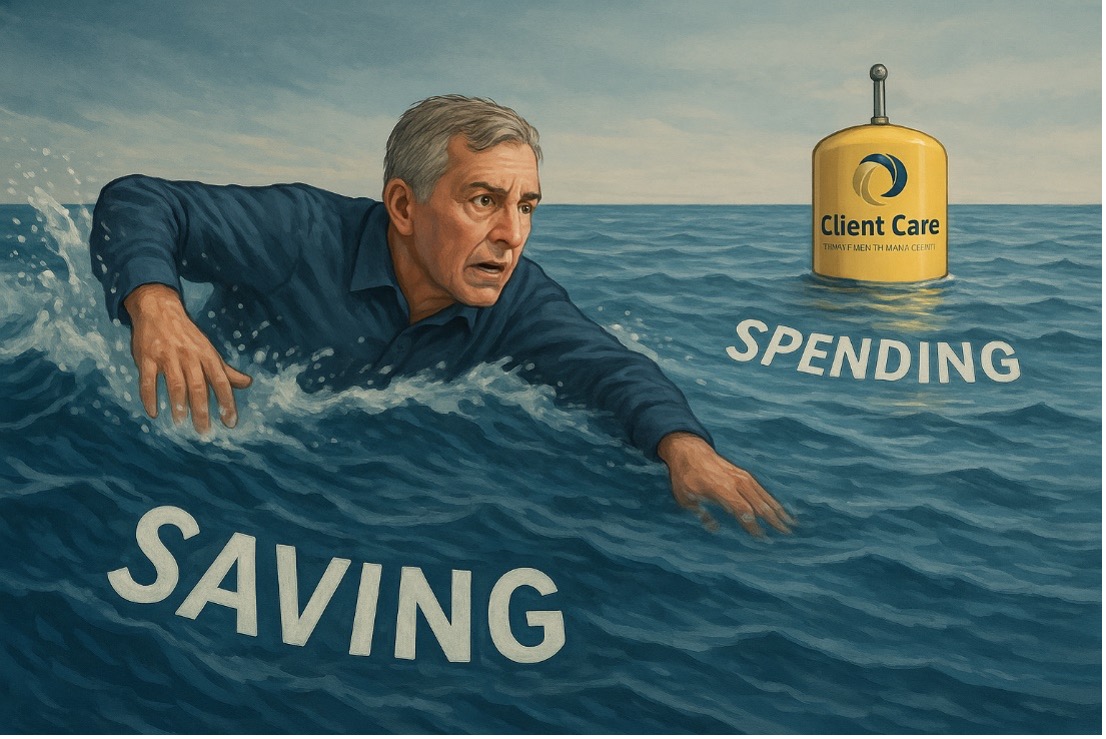
The move from saving and building wealth to spending that wealth in a way that brings them true happiness.

I see many people who have what they want, huge wealth, but not what they need, real happiness. For many being a saver has become part of their identity and making the change to spending that wealth is a massive challenge. What makes this challenge more complicated is that even when some people do spend money it does not necessarily make them any happier,
In his book The Art of Spending Money, Morgan Housel says: There are two ways of spending money. One is as a tool to live a better life. The other is as a yardstick of status to measure yourself against others. Many people aspire for the former but spend their life chasing the latter.
We are all different and what makes one person happy does not necessarily make another person happy. Often, we do what we think people expect of someone with our level of wealth should do and are still left feeling disappointed and unhappy.

A simple lifestyle does not mean that we cannot live with nice things in a beautiful home and enjoy wonderful holidays. These things can make life easier and more comfortable, but what is important is that we choose this life based on our own values and needs and not because everyone else who looks like me is doing it.
Most people spend their life making a living, don’t be someone who forgets to build a life.
Dirk Groeneveld, Certified Financial Planner
t. 083 261 9287
e. dirk@clientcare.co.za
—

by SFT | Nov 25, 2025 | Financial Planning, St Francis
Finding yourself again after work ends
There’s a moment in retirement that no one prepares you for. It doesn’t happen on your last day in the office, or at the farewell drinks, or even that first Monday morning when you wake up with nowhere to rush to.
It arrives later—quietly—when you realise your job title is gone, and with it, the easy identity you carried for decades. Suddenly, you’re not “the engineer” or “the director” anymore. You’re just… you. And for many, that silence is far more unsettling than any fear of running out of money.

For most of our working lives, our job title becomes a shortcut—social proof, structure, and a ready-made answer to “What do you do?” We don’t notice how much we lean on it until it disappears. Then retirement arrives and, without warning, removes the scaffolding we didn’t know was holding us upright.
A lot of retirees tell me the same thing: “I thought I was ready.” They had spreadsheets, pension statements, maybe even a bucket list. But very few were prepared for the emotional transition. Your brain has spent 30 or 40 years built around one central narrative: I am someone who contributes in this specific way. Remove that, and it’s normal to feel a bit lost.
It’s no surprise that studies show the highest spike in retirement-related anxiety isn’t before retirement—it’s in the first year after stopping work. Not because of boredom. Not because of money. But because of identity.
Some experience it as a quiet grief. Others feel guilty for not “loving every minute” of this new freedom. Many feel unanchored, as if they’ve stepped out of a life that once made sense.
But here’s the truth I’ve seen again and again: your job title wasn’t your identity. It was just the most convenient version of it.
Retirement doesn’t erase who you are—it reveals who you’ve always been beneath the performance. This next chapter isn’t about filling your diary; it’s about rediscovering the parts of yourself that never fitted neatly into a business card.

And yes, that takes courage. But those who do the work describe the same feeling: not a euphoric high, but a quiet rightness. A long exhale after years of holding their breath.
The end of your career isn’t the end of your identity.
It’s the moment you finally get to build one of your own.
—
Dirk Groeneveld, Certified Financial Planner
t. 083 261 9287
e. dirk@clientcare.co.za
—
by SFT | Nov 17, 2025 | Financial Planning, St Francis
As we near and enter retirement chances are that we have as much financial wealth as we have had in our working lives. If we have a well-planned, financially secure retirement to look forward to, we may also have some spare cash to splash on nice things that we think we want. The dopamine hits we get from accumulating these things can give a lot of pleasure but unfortunately those good vibes don’t always last as long as we would like.

After a while we have all the stuff and toys we could want and more. Our yards, garages and storage facilities are full of clutter, and yet our happiness bank balance is not necessarily any higher? Kind of disappointing, isn’t it? What’s the answer?
The research is clear
The research is clear, the joy we get from buying things drops faster than our willpower on a new year’s resolution. Experiences, on the other hand, age better than a single malt Scottish Whisky. The memory dividend grows, compounds, and pays out long after the moment has passed.

It’s difficult to let go of stuff that we have accumulated over our lifetimes, but the risk we run if we don’t clear out a bit is that with too many options we end up procrastinating and doing nothing. Boredom and indecision can be paralysing if we don’t get on top of things.
Short Term Highs
We are naturally social beings so spending time with family and the people who bring joy to our lives garantees lasting happiness. This doesn’t mean we stop buying things, but buying our stuff with real purpose to make those interactions more comfortable or fun, can give both short term highs and long term memories.
That new driver or hybrid that makes up for the distance you used to be able to hit off the teebox, the ebike that means you can ride with your mates and not need to sleep the rest of the day. These things make life more fun, healthier and happier.
So I’m not saying stop spending, just spend with purpose. After all, we can’t take it with us?
Dirk Groeneveld, Certified Financial Planner
t. 083 261 9287
e. dirk@clientcare.co.za
—
Previous Columns:
by SFT | Nov 9, 2025 | Financial Planning
Over the years, I’ve seen first-hand how much unnecessary stress and heartache can follow when someone passes away without a valid Will. It’s one of those things most people mean to “get to soon,” but never quite do. The result? Their family ends up in the hands of the Intestate Succession Act—a rigid piece of legislation that decides who gets what. While the law does its best to be fair, it can’t possibly understand the unique relationships, intentions, and values that make up a family’s story.
A Will is not just a legal document. It’s your voice when you’re no longer here to speak. Without it, you leave your loved ones to navigate a long, complex, and often emotionally draining process—right when they’re least equipped to do so.

Who Gets What
If you die without a Will, your estate will be divided according to a strict formula set out in law. Your spouse, children, parents, or even distant relatives could inherit—depending on who’s still alive. If you have no heirs at all, your estate eventually goes to the State. It’s a system that works on paper, but in reality, it seldom reflects what you would have wanted.
Having a Will allows you to decide exactly how your assets should be distributed. You can include friends, charities, or even set up a trust to support someone you care for. In short, it lets you ensure that your money ends up where your heart intended it to go.
Marriage Matters
How your estate is split also depends on how you’re married.
If you’re married in community of property, half of everything already belongs to your spouse.
If you’re married out of community of property with accrual, your spouse may have a claim for their share of the growth in your estate.
These technicalities can get complicated, but the key point is this: your Will needs to align with your marriage contract. A good planner or estate specialist can help ensure that your intentions are carried out without legal friction or financial surprises.

Choosing an Executor
When there’s no Will, no executor has been nominated. That means the Master of the High Court must appoint someone to wind up your estate—often a stranger to your family. This can delay the process and add unnecessary cost.
When you have a Will, you can nominate your own executor—ideally someone you trust, or a professional who knows your affairs. You can even agree on their fee in advance, saving your estate both time and money.
What About the Children?
This is the part that worries me most. If both parents pass away without Wills, the courts decide who will look after the children. The person chosen may not be who you would have wanted. In addition, any inheritance left to minors automatically goes into the state-managed Guardian’s Fund, where access is slow and the returns poor.
A simple clause in a Will can prevent all this. You can nominate a guardian you know and trust, and set up a testamentary trust to protect and manage the inheritance until your children are old enough to handle it themselves. That’s true peace of mind.

The Price of Doing Nothing
It’s tempting to think “I don’t have much, so it doesn’t matter.” But this isn’t about wealth—it’s about love, intention, and responsibility.
Without a Will, your family could face months of delays, extra costs, and painful uncertainty. With one, you leave clarity, order, and—most importantly—care.
A well-drafted Will is one of the simplest and most powerful gifts you can give your family. It ensures that what you’ve built during your lifetime is passed on with purpose, not paperwork.
So if your Will is out of date—or if you don’t have one at all—please don’t put it off. Take the time now to make sure your voice will be heard, and your loved ones protected, long after you’re gone.
Dirk Groeneveld, Certified Financial Planner
t. 083 261 9287
e. dirk@clientcare.co.za
—
Previous Columns:

by SFT | Nov 3, 2025 | Financial Planning, St Francis
It’s November already—and I don’t know about you, but 2025 feels like it’s flown by even faster than last year. The older I get, the more it seems that time doesn’t just pass—it accelerates. Maybe it’s because our lives are fuller, or perhaps it’s because we’ve learned how precious time really is. Either way, here we are, on the doorstep of another festive season.

For many retirees, the next few months are going to be wonderfully busy. Some of us will be packing bags to visit children and grandchildren for Christmas, while others will be preparing for family to descend on St Francis for their summer break. The town will soon be humming with energy, laughter, and the smell of sunscreen and braais. It’s a special time—but let’s be honest, it can also be stressful.
Curveballs have a way of sneaking in just when we think we’ve got everything under control. A sudden health issue—ours or someone else’s—a flare-up of old family tensions, or a few too many unexpected expenses can easily upset the balance. The best way to keep the season joyful is to prepare as much as possible.
Start with the basics. Make sure the cash or funding you expect to need is available and accessible. Book restaurants and activities early—nothing spoils the mood like being turned away when the kids are hungry and the grandkids are restless. If you’re planning family activities like golf days, boat trips, or a bit of fishing, get them on the calendar now. Sort out accommodation early so that everyone feels welcome and comfortable.

It all sounds obvious, but it’s the “obvious” things that most often slip through the cracks. The same goes for Christmas gifts—decide upfront how you want to handle them so that everyone feels thought of and treated fairly.
We often think that family harmony will just happen naturally because it’s the festive season. But as most of us know, the words “normal” and “family” rarely appear in the same sentence. Every family is unique—and that’s what makes it special—but it also means a little planning goes a long way.

Finally, spend your money where it matters most: on creating shared experiences and lasting memories. A family outing, a day on the water, or a meal filled with laughter will be remembered long after the wrapping paper’s been thrown away.
Because at the end of the day, that’s what true wealth looks like.
—
Dirk Groeneveld, Certified Financial Planner
t. 083 261 9287
e. dirk@clientcare.co.za
—
Previous Columns:






Recent Comments