
by SFT | Feb 8, 2026 | Financial Planning, St Francis
The word budget is one of the most emotionally loaded words in personal finance. For some, it signals discipline, control, and clarity. For others, it feels like a set of handcuffs — restrictive, joyless, and designed to take the fun out of life.
What’s interesting is that these two very different reactions often exist in the same person.

Essential Tool
In business, a budget is rarely questioned. It’s seen as an essential tool — a framework that guides decision-making, keeps spending aligned with strategy, and ultimately supports growth and sustainability. Most successful business owners are disciplined, deliberate, and respectful of their business budgets.
Yet in their personal lives, many of these same people behave very differently. Spending becomes more casual, less intentional, and often reactive. There’s a quiet assumption that things will somehow work out, even when no clear plan exists.

Cashflow Framework
Some try to escape the discomfort by changing the language. “Spending plan”, “cashflow framework”, or other softer labels are introduced in the hope that this will remove the negativity. It rarely does. Deep down, we all know what’s being avoided — not the word itself, but the emotions and beliefs we attach to it.
The truth is this: a budget can be both restrictive and liberating. Which one it becomes depends entirely on your attitude towards money and life.
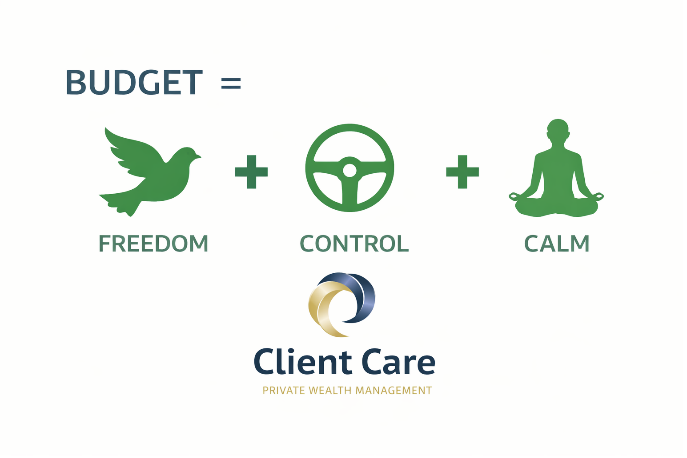
A well-constructed budget isn’t there to punish you or rob you of enjoyment. Quite the opposite. It’s a tool that puts you back in control. It allows you to consciously decide where your hard-earned money goes, rather than wondering where it went.
When you don’t budget, wastage creeps in quietly. Money leaks into areas that add little real value, while the things that truly bring joy, meaning, and satisfaction are often postponed or underfunded. Over time, this lack of intention can lead to two very real risks: running out of money too soon, or realising — too late — that money was never the problem. The absence of clarity was.
Spending With Intention
This becomes especially important as we approach retirement. Financial stress is the last thing anyone wants in this phase of life. Spending with intention allows you to sleep well at night, knowing that your lifestyle is sustainable and aligned with what truly matters to you.
A budget doesn’t limit your life. Used properly, it gives you permission to live it — deliberately, confidently, and without regret.
Dirk Groeneveld, Certified Financial Planner
t. 083 261 9287
e. dirk@clientcare.co.za
Recent columns:
– Financial Planning, What It Really Is
– Planning Retirement Properly: Turning Wealth Into a Life Well Lived

by SFT | Jan 25, 2026 | Financial Planning, St Francis
Many product providers—discount brokers, investment platforms, fund managers—are marketing themselves as offering “financial planning”. Scratch beneath the surface, though, and what they really mean is an investment review dressed up with better language.
An investment plan is not a financial plan. Confusing the two does clients a disservice.
If all you receive is a portfolio review, that is not financial planning.
If the focus is only on insurance, that is not financial planning.
If the conversation is limited to retirement projections, that is not financial planning.
Each of these elements matters. But none of them, on their own, represents the whole.

This distinction matters because decisions made in isolation are almost always inferior to decisions made in context. Without understanding the full picture of someone’s life, values, goals, family situation, and trade-offs, advice on any one area becomes diluted at best—and misleading at worst. It’s also why the classic question, “Should I buy Bitcoin or this hot new stock?” is almost impossible to answer without first understanding what role, if any, that decision plays in a broader plan.
True financial planning starts with life, not products.
Investment planning is not about selling funds or chasing returns. It’s about understanding how all the assets in your life—investments, property, businesses, and even future opportunities—work together to support the life you want to live.
Insurance planning isn’t about ticking boxes or buying policies. It’s about managing risk thoughtfully: avoiding what you can, reducing what you must, and only then transferring risk where it makes sense.
Cash flow planning isn’t just for people who are struggling. It’s the engine of every good plan. Without clarity on income and spending, everything else is guesswork.
Tax planning is not submitting a return once a year. It’s ongoing, long-term thinking about how decisions today affect outcomes years or decades from now.
Retirement planning isn’t about hoarding money until some arbitrary age. It’s about building flexibility, independence, and the freedom to enjoy life while you’re healthy enough to do so.
Estate planning isn’t about paperwork you don’t understand. It’s about intention, clarity, and the legacy you want to leave behind.

Real financial planning brings all of this together. But at its centre is not money—it’s you. Your priorities, fears, hopes, values, and definition of a life well lived. When planning starts there, the numbers begin to make sense. When it doesn’t, they never really will.
Dirk Groeneveld, Certified Financial Planner
t. 083 261 9287
e. dirk@clientcare.co.za
—

by SFT | Jan 19, 2026 | Financial Planning, St Francis
For most of our working lives, we are conditioned to save. Save consistently. Save diligently. Save just in case. And while this habit is essential, it can quietly become a trap if it’s never revisited.
Retirement is not simply a financial event. It’s a life transition. And like any meaningful transition, the quality of the outcome depends far more on planning than on the size of the balance sheet.
Too many people approach retirement forwards—accumulating wealth without ever asking what that wealth is meant to support. A better approach is to plan backwards. Start with the life you want to live and, just as importantly, the life you want to avoid. Regret is often clearer than aspiration. Knowing what you don’t want—poor health, isolation, boredom, dependence—creates far better plans than vague dreams of “enjoying retirement someday.”

Time, not money, is the most precious resource in retirement. There is a window—often early in retirement—when health, energy, and curiosity align. These are the “go-go years,” and they matter. Travel postponed, experiences delayed, and memories deferred don’t compound like money does. Once health declines, opportunities close, regardless of how large the portfolio remains.
This is where many retirees struggle: the transition from saving to spending. After decades of discipline, spending can feel reckless—even when it’s entirely sustainable. Without a proper plan, fear fills the gap, and people underspend their lives away, only to leave behind wealth they never truly used.
A solid financial plan changes this dynamic. It provides clarity. It answers the most important question: Am I going to be okay? With that confidence, spending becomes purposeful rather than emotional. Enjoyment becomes responsible, not indulgent. Wealth becomes a tool, not a scoreboard.

True wealth is not measured by what we die with, but by how we live while we’re here. The memories we create. The relationships we nurture. The freedom to choose.
This is why working with a financial planner who holds you accountable matters. Not someone focused on markets and products, but someone focused on your life—helping you align your money with your values and guiding you toward a dignified, fulfilling retirement.
Because in the end, money has only one real job: to help you live your best possible life, while you still can.
Dirk Groeneveld, Certified Financial Planner
t. 083 261 9287
e. dirk@clientcare.co.za
—

by SFT | Jan 11, 2026 | Financial Planning, St Francis
If you’ve been paying attention to financial media lately, you’ll have seen increasingly anxious commentary about market concentration. The warning is familiar: the top 10 companies now make up a larger portion of global equity indices than ever before. Most of them are technology and AI-driven businesses, and the implication is clear—if these giants stumble, your portfolio will too.
It’s a concern worth acknowledging. But before reacting, it’s important to understand what’s really going on beneath the surface.

First, these are not “10 companies” in the way we traditionally think about them. They are vast ecosystems made up of multiple businesses, many of which could easily stand on their own as large, publicly listed companies.
Take Apple as an example. Its AirPods business alone is estimated to generate around $20 billion a year in revenue—larger than Spotify, Nintendo, eBay, or Airbnb. The same could be said for Apple’s Mac, iPad, and Wearables divisions. If Apple were broken into its component parts, the index would instantly look far more diversified, without you owning anything different.

This pattern repeats across the so-called top 10. YouTube, tucked inside Alphabet, generates over $50 billion in annual revenue. Amazon’s cloud business, AWS, now exceeds $100 billion. Microsoft houses Azure, Office, LinkedIn, and Xbox—each a major enterprise in its own right. What looks like concentration is, in part, a quirk of corporate structure.
It’s also worth remembering that market concentration is not new. There has always been a dominant group driving returns. In the 1980s it was oil and industrial companies. In the late 1990s it was telecoms and dot-coms. The names change, but leadership concentration is a constant feature of markets.
What is different today is the quality of earnings. These companies are not priced on hope alone. They generate substantial profits from products and services used by billions of people daily. That doesn’t make them invincible, but it does make today’s concentration very different from past excesses.
Importantly, the index is not static. If these companies disappoint, their weight will naturally shrink. Index investing is self-correcting by design—it quietly reduces exposure to what’s fading and increases exposure to what’s rising, without requiring predictions or heroic decisions.

The practical question is this: even if concentration leads to lower returns ahead, what’s the alternative? Guessing future winners? Moving to cash? Each carries its own risks and relies on forecasts we know are unreliable.
For long-term investors, today’s concentration is unlikely to be the deciding factor. Broad diversification across thousands of companies remains the most sensible strategy—even when a handful currently dominate the headlines.
And as always, if you’d like to talk through what this means for your own situation, we’re here.
Dirk Groeneveld, Certified Financial Planner
t. 083 261 9287
e. dirk@clientcare.co.za
—

by SFT | Jan 8, 2026 | Financial Planning, St Francis
As we move into a new year, market predictions abound. They always do. Newspapers, podcasts, investment houses, and social media feeds fill up with confident forecasts about what the coming year will bring. And almost without exception, most of them will be wrong. 2026 will be no different.
A useful reminder of this came from an exercise run by Forbes in early 2025. They asked 34 billionaires how they thought the S&P 500 would perform over the year. If anyone should have insight, resources, and access to information, surely it would be them. And yet, the results were sobering.

The S&P 500 ended 2025 up 16% – an above-average return by historical standards, given that the index has delivered around 10% per year over the past seven decades. It was lower than the exceptional returns of 2023 and 2024, but still a very good year for equity investors.
The billionaires didn’t see it coming. Nearly half believed the market would be flat or down. Another 35% expected positive returns, but only in the single digits. Just 7 out of the 34 – about 21% – correctly anticipated a return in the 10% to 20% range.
If even billionaires and so-called market masters can’t reliably predict what markets will do, what chance does the normal person in the street have?

This is precisely why real wealth is not built by trying to call the next best thing or by reacting to predictions. It is built by staying in the market, through good years and bad, and by allowing time and compounding to do the heavy lifting.
This is also why your investment strategy should never exist in isolation. It should be built after – or at least alongside – a proper personal financial plan. The plan defines what you are trying to achieve. The investments are simply the tools used to get you there.

In our experience, the simpler the investment strategy, the better. Complexity rarely improves outcomes, but it almost always increases the chance of poor behaviour at the wrong time. The best investment strategy is not the most exciting or sophisticated one. It is the one you understand, believe in, and will actually stick to when markets become uncomfortable.
Predictions will keep coming. They always do. The discipline to ignore them is one of the greatest advantages an investor can have.
—
Dirk Groeneveld, Certified Financial Planner
t. 083 261 9287
e. dirk@clientcare.co.za
—
by SFT | Dec 23, 2025 | Financial Planning, St Francis
January has a way of prompting reflection. A new year arrives and with it the familiar questions: Should I change something? Should I do more? Should I slow down?
For many people, the honest answer is simple: I’m fine.
And on the surface, that’s a good thing. Life is stable. The bills are paid. Health is reasonable. There’s food on the table, a roof overhead, and perhaps even the freedom to live in a place many others would envy. Compared to the alternatives, “fine” feels like something to be grateful for.

But over the years, I’ve come to believe that “I’m fine” can be one of the most dangerous phrases we tell ourselves.
Not because it’s untrue — but because of what it quietly allows.
“I’m fine” often becomes a full stop instead of a comma. It closes the door on deeper questions. It postpones decisions that feel important but not urgent. It gives us permission to drift.
When life isn’t actively painful, we rarely feel the need to examine it closely. We settle into routines. We default to what’s familiar. We assume there will be time later — later to travel, later to reconnect, later to focus on health, later to live a little differently.
And later has a habit of arriving much faster than expected.
I see this often in my work with retirees and those approaching retirement. On paper, things look good. Assets are sufficient. Spending is modest. There’s no immediate financial stress. Yet beneath the surface, dreams have been quietly deferred and experiences postponed. Money, carefully accumulated over decades, remains largely untouched — not because it’s needed for security, but because there’s no clear permission to use it.

Comfort is subtle that way. It doesn’t shout. It whispers. It convinces us that maintaining the status quo is sensible and responsible. And in many areas of life, it is.
But comfort without intention can slowly turn into regret.
This isn’t a call for reckless change or dramatic reinvention. What most people need is something far simpler — deliberateness. Deliberateness about how they spend their time, how they use their money, and which relationships and experiences they prioritise while they still can.
As we move into a new year, perhaps the most useful question isn’t “Am I fine?”
It’s: “Am I living intentionally, or just comfortably?”
Because a comfortable life can be a wonderful thing — as long as it doesn’t quietly replace a meaningful one.
—
Dirk Groeneveld, Certified Financial Planner
t. 083 261 9287
e. dirk@clientcare.co.za
—





Recent Comments