

Last week, I attended two financial planning conferences. I believe that ongoing learning is vital to getting and staying at the top of one’s game. What was particularly refreshing about these events was having financial planners from the United Kingdom attend and present on how they run their businesses and advise their clients.
Much like our approach at Client Care, these financial planners’ focus is on more than just their clients’ money, but also on how to help them live their best life with what they have. Dan Haylett, one of the speakers, uses sketches to illustrate to his clients concepts he believes are important. One sketch that really resonated with me highlights what he believes to be the two most important words for any retiree: YES and NO.
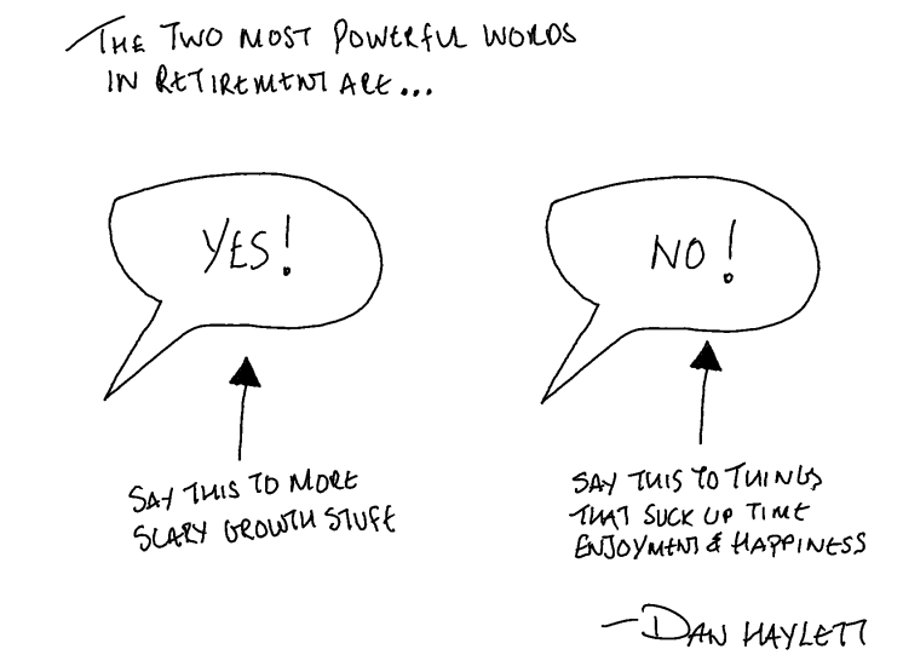
At the outset, this may seem like an easy concept to follow, but in real life, it is often a lot harder to do. A good way to apply this would be to write down two lists. The first should contain all the things that make your life happy, fulfilling, and meaningful. This could include things such as time with family and the people you care about, any hobbies that you enjoy, be it golf or reading, or causes or passions that allow you to fulfil your personal values.
The second list might be a bit harder to draft, as we have to admit to things we really loathe or things that stress us out but we still do because we believe we are expected to do them. We all have people that count on us in different ways, be it financially or emotionally. We need to make sure that we keep a healthy balance here because, to be able to be there for others, we first need to be in a good place ourselves.

Once the lists have been drawn up, we should see which is longer, as that is likely to indicate our current mental, physical, and emotional state. The ideal balance we want is to have a lot more things on the YES list than on the NO list, so this is a “healthy imbalance”.
One might find that on each list, there is low-hanging fruit: things we can do on the YES list and things we can stop doing on the NO list. Next would be to take a hard look at the things that make our gut churn when we think about them and explore ways of getting rid of them forever. This may be tough, but imagine life after taking action!

Thank goodness we are all different, so no two people’s lists should look the exact same, and we should respect that, especially with our significant other (spouse). Do this together or try it alone, it might surprise you how easy it is to do!
Dirk Groeneveld, Certified Financial Planner.
- t. 083 261 9287
- e. dirk@clientcare.co.za
- web. Client Care Lifestyle Financial Planning
Previous Columns:
- Navigating the Phases of Retirement: A Roadmap for Transition
- What is a Family Constitution?
- Planning for the Unknowns
- The Importance Of Proper Cashflow Planning
- New St Francis Bay Quarterly Retirement Event.
- Beware of Ponzi Schemes: Safeguard Your Finances During the Festive Season
- The real cost of financial advice




Recent Comments